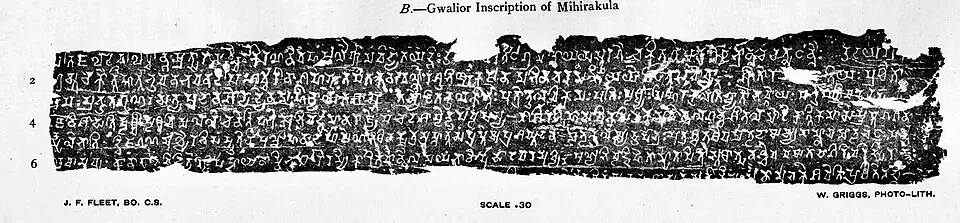
Matṛceṭa's Sun Temple Inscription at Gwalior
Mihirakula Praśasti · मिहिरकुल प्रशस्ति
A sixth-century Sanskrit inscription from Gwalior Fort records the building of a Sūrya temple on the Gopa hill. Though linked with the Hūṇa king Mihirakula, it was commissioned by his official Mātṛceṭa. It also names Toramāṇa and Mihirakula and survives only in a damaged slab.
The Gwalior inscription of Mihirakula is a Sanskrit text of the sixth century noting how a Sūrya temple was raised inside Gwalior Fort, using stone from the Gopa hill. Although it now carries the name of Mihirakula, the temple and its inscription were commissioned by his official Mātṛceṭa. The original temple is lost. Alexander Cunningham found the inscribed red-sandstone slab in 1861 inside the porch of a different temple, publishing it that same year, and it was soon moved to a museum in Kolkata for safekeeping. Several translations have since appeared. The slab is damaged, its script is the northern variety of the Gupta script, and the whole composition is written in verse. The inscription is valued for naming, early in the sixth century, the two Hūṇa kings Toramāṇa and Mihirakula, which gives historians firm evidence for their rule in central India. The year 520 is an approximate marker for its date, since the record is tied to a regnal year of Mihirakula and the conversion to the common era is estimated.
Sources
- Gwalior inscription of Mihirakula Wikipedia · CC-BY-SA-4.0
- Q5623269 Wikidata · CC0-1.0