Badami Cave Temples Carved in Chalukya Vātāpī
Bādāmi · बादामी
The Badami cave temples, cut into sandstone at Vātāpī, the early Chalukya capital in Karnataka, include Hindu, Jain and Buddhist shrines from the sixth century onward. They are among the earliest known Hindu temples in the Deccan and helped shape later temple design.
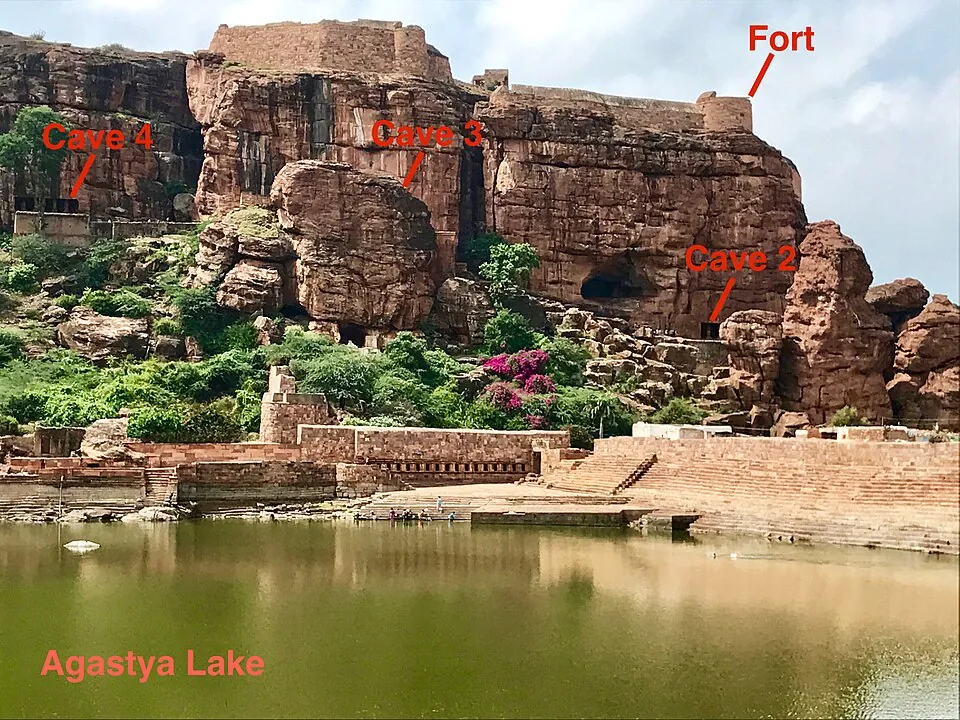
Badami, once called Vātāpī, served as the seat of the early Chalukyas, a dynasty ruling most of Karnataka from the sixth to the eighth century. On the southeast side of the town, set in a soft sandstone escarpment above a man-made lake, the Chalukyas had cave temples cut, and the earliest date from the sixth century. The complex holds Hindu, Jain and Buddhist caves, and it ranks among the finest examples of Indian rock-cut architecture. Four caves are the main attraction. Cave 1 includes a prominent carving of Śiva dancing as Naṭarāja, and Cave 2 has a similar plan with sculptures of Harihara, Ardhanārīśvara, Mahiṣāsuramardinī and others. Together with the temples at nearby Aihole, these monuments turned the valley of the Malaprabha river into a cradle of temple building, whose forms influenced the design of Hindu temples built later in other regions. The lake is bordered by an earthen wall with stone steps, and forts of early Chalukya and later date stand to the north and south. The date given marks the start of the carving.
Sources
- Badami cave temples Wikipedia · CC-BY-SA-4.0
- Q825236 Wikidata · CC0-1.0