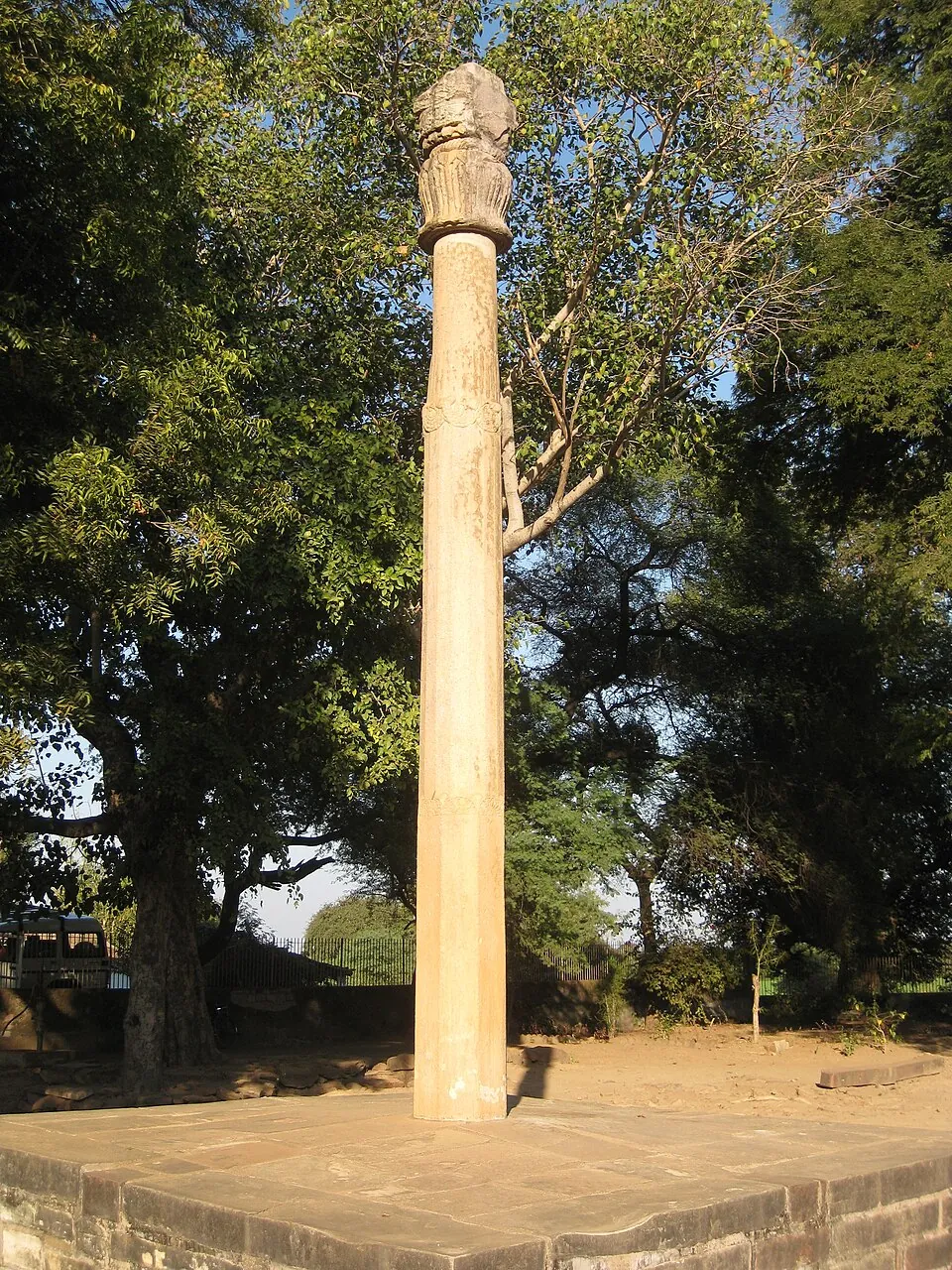
Heliodorus Raises a Garuḍa Pillar at Besnagar
Around 113 BCE the Greek ambassador Heliodorus, sent by the Indo-Greek king Antialcidas, set up a stone pillar at Besnagar near Vidiśā. Its Brāhmī inscription honours Vāsudeva as God of Gods, making it an early record of Vaiṣṇava devotion by a foreigner.
The Heliodorus pillar stands at Besnagar, modern Vidisha in Madhya Pradesh, and is dated to about 113 BCE. Its inscription names Heliodorus as an envoy of the Indo-Greek king Antialcidas of Taxila, sent to the local ruler Bhāgabhadra. Written in Brāhmī, the dedication honours Vāsudeva, Kṛṣṇa, as the 'God of Gods' and supreme deity, and Heliodorus describes the column as a Garuḍa standard. It also praises Bhāgabhadra as 'the saviour'. The pillar is a stambha, a form understood as linking earth, sky and heaven and as expressing a cosmic axis. The site lies near the meeting of two rivers, about 60 kilometres northeast of Bhopal, a short distance from the Buddhist stūpa of Sāñcī and the Hindu site at Udayagiri. Alexander Cunningham found the pillar in 1877, and two major excavations were carried out in the twentieth century. It is widely cited as evidence that Greeks in India adopted Bhāgavata worship around the second century BCE.
Sources
- Heliodorus pillar Wikipedia · CC-BY-SA-4.0
- Q1854330 Wikidata · CC0-1.0