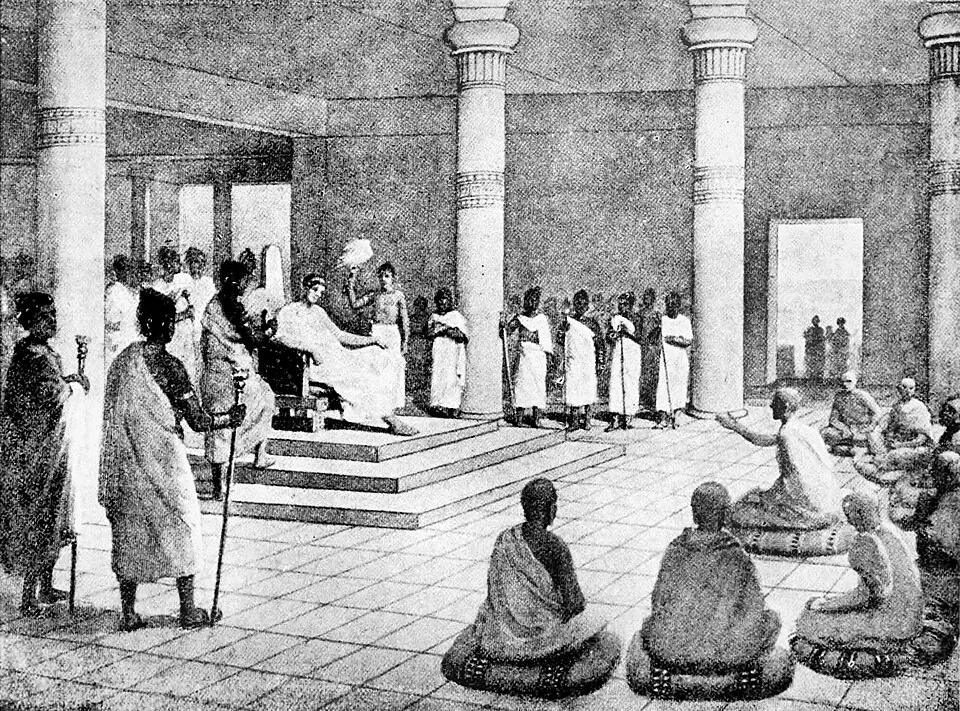
The Milindapañha, Questions of King Milinda
Milindapañha · मिलिन्दपञ्ह
The Milindapañha is a Buddhist work, composed between about 100 BCE and 200 CE, that records a dialogue between the sage Nāgasena and the Indo-Greek king Menander I, known as Milinda. It examines self, rebirth and karma through question and analogy, and is canonical in Burmese Buddhism.
The Milindapañha, or Questions of Milinda, presents a conversation between the Buddhist monk Nāgasena and Milinda, the Greek name Menander, an Indo-Greek king of the second century BCE who ruled in north-western India. The king poses sharp philosophical puzzles about the self, rebirth, the effects of action and the nature of liberation, and the monk answers with analogies and similes, the best known of which compares a person to a chariot made of parts. The work as it survives is dated to sometime between 100 BCE and 200 CE, so it was composed well after the king's lifetime and should be read as a literary dialogue and not a transcript. Its status differs by region. Burmese Buddhism regards it as canonical and includes it in the Khuddaka Nikāya, whereas Thai and Sri Lankan traditions do not, even though the surviving Theravāda text is preserved in Sinhalese script. A shorter version appears in Chinese Mahāyāna translations as the Monk Nāgasena Sūtra, which matches the first three chapters of the Pāli text.
Sources
- Milinda Panha Wikipedia · CC-BY-SA-4.0
- Q497089 Wikidata · CC0-1.0