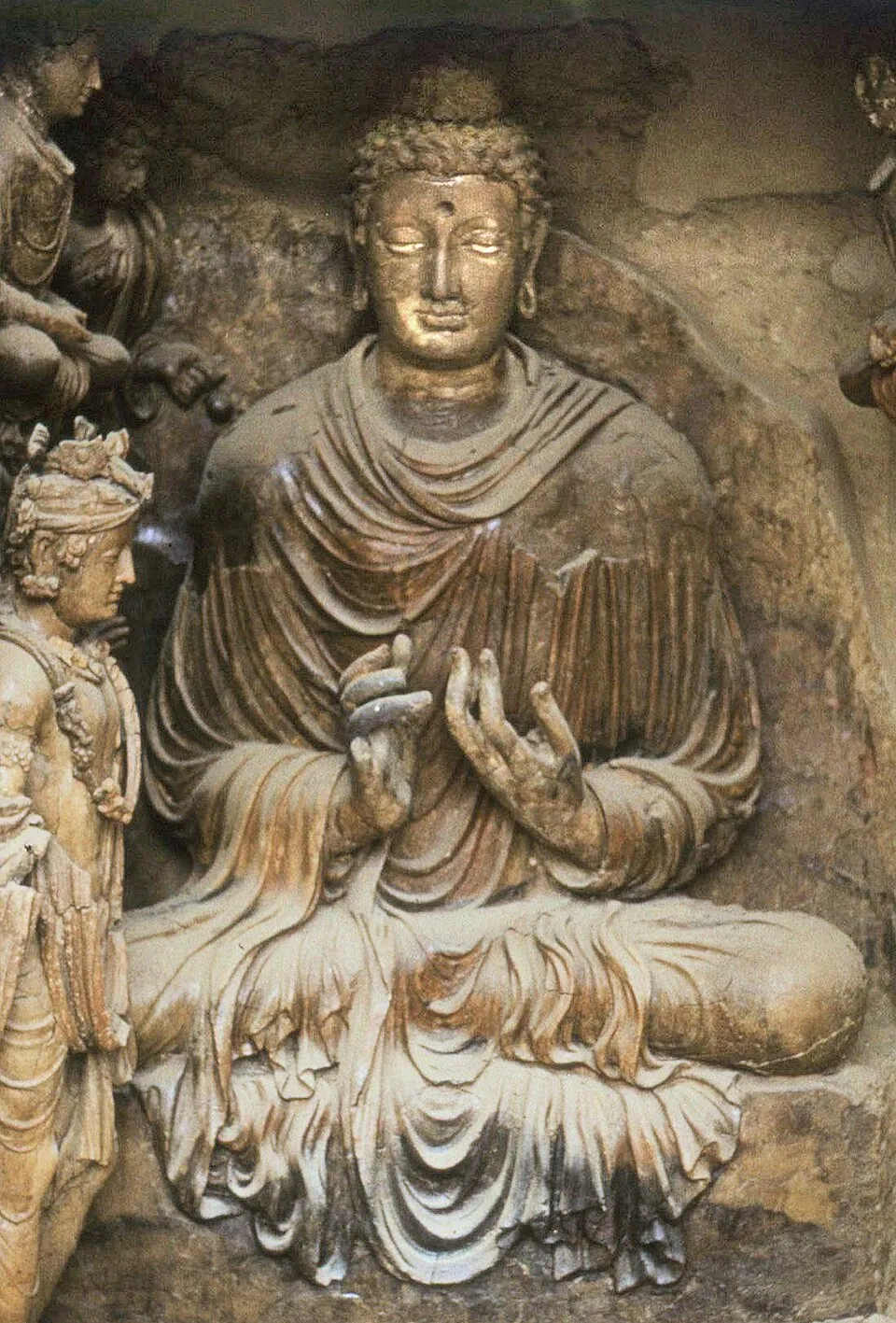
The Sarvāstivāda School and Its Abhidharma
Sarvāstivāda · सर्वास्तिवाद
The Sarvāstivāda, an early Buddhist school dating from about Aśoka's time, held that phenomena exist in past, present and future. It was known for seven canonical Abhidharma texts and flourished in Kashmir and Central Asia until the seventh century CE.
The Sarvāstivāda was among the early Buddhist schools, taking shape around the reign of Aśoka in the third century BCE. Its name can be understood as the doctrine that all exists. The school argued that dharmas, the basic elements of experience, exist in all three times: past, present and future. Vasubandhu's Abhidharmakośa-bhāṣya sums up the idea by calling anyone who affirms the reality of dharmas across the three times a Sarvāstivādin. Its monks were known above all as an Abhidharma tradition, with a distinctive set of seven canonical treatises. The community became one of the most influential monastic groups in northern India, with strongholds in Kashmir and Central Asia, and it persisted until about the seventh century CE. During the age of Kaniṣka, roughly 127 to 150 CE, its orthodox Kashmiri wing compiled the vast Abhidharma Mahāvibhāṣā Śāstra, and adherents of the doctrines set out there are called Vaibhāṣikas. The year used here marks this high point of the school, not its origin.
Sources
- Sarvastivada Wikipedia · CC-BY-SA-4.0
- Q633994 Wikidata · CC0-1.0