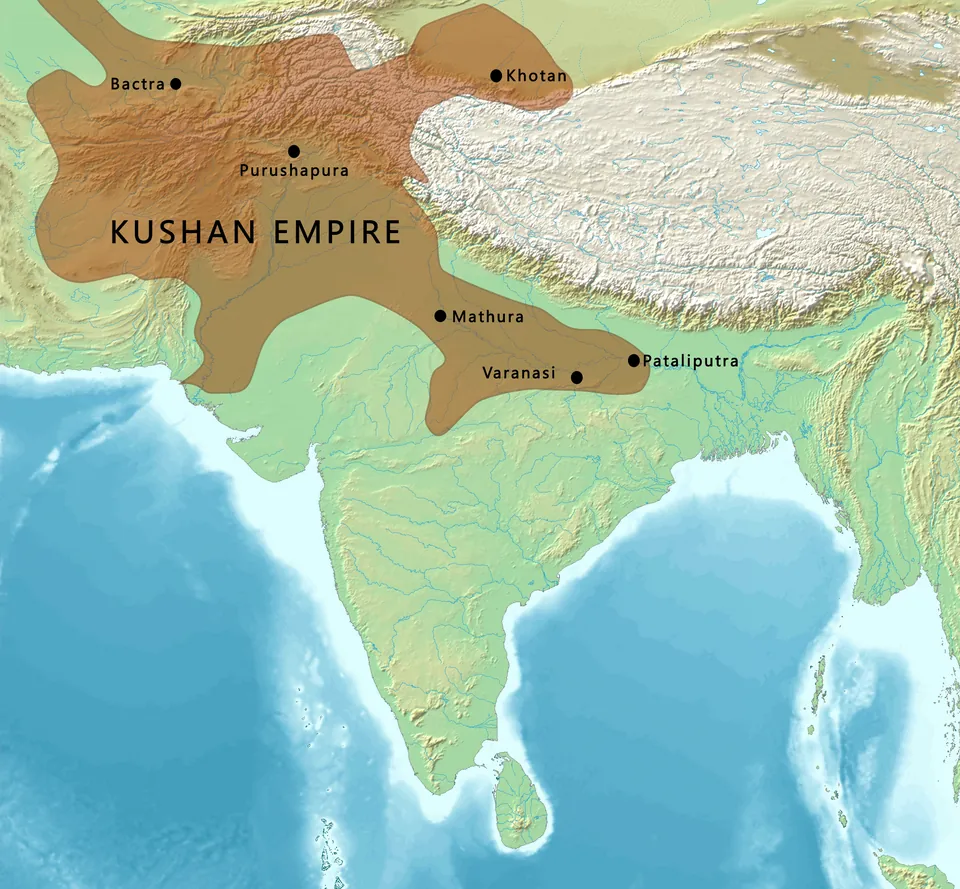
The Kushan Empire Spans Bactria and North India
Kuṣāṇa Sāmrājya · कुषाण साम्राज्य
The Kushan Empire, formed by Yuezhi peoples in the early first century CE, ruled from Bactria across much of Afghanistan, Pakistan and northern India for about three centuries. Its emperors patronised Buddhism and Śaiva worship alike, and its peace helped Buddhism travel to Central Asia and China.
The Kushan Empire lasted from about 30 to about 375 CE and grew from a confederation of Yuezhi nomads who had migrated from north-western China and settled in Bactria. From that base it expanded to take in much of today's Afghanistan, Pakistan and Central Asia, together with a large part of northern India. Inscriptions from the reign of Kaniṣka the Great, found at Sāketa and Sārnāth near Vārāṇasī, show how far the Kushan writ ran into the Gangetic plain. The founder, Kujula Kadphises, drew on Iranian and Greek ideas and imagery inherited from the Greco-Bactrian world, and he and later rulers such as Vima Kadphises and Vāsudeva II followed Śaiva worship. The dynasty was also a great patron of Buddhism, and from Kaniṣka onward its pantheon included Zoroastrian elements. Because it sat astride the overland routes, the empire helped carry Buddhist teaching to Central Asia and China, and it gave the region roughly two centuries of relative stability, sometimes called the Pax Kushana. The year here marks the reign of Kaniṣka, the empire's best-known ruler, whose coinage and art reveal a strikingly mixed cultural world.
Sources
- Kushan Empire Wikipedia · CC-BY-SA-4.0
- Q25979 Wikidata · CC0-1.0