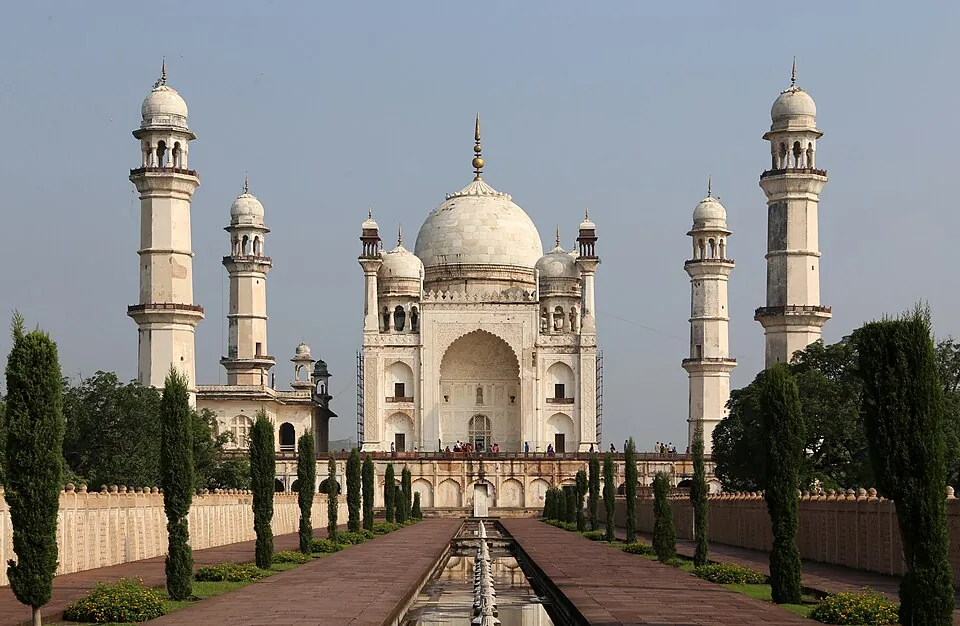
Bibi Ka Maqbara, the Taj of the Deccan
Bībī kā Maqbarā · बीबी का मक़बरा
The Bibi Ka Maqbara in Aurangabad was commissioned about 1660 by Prince Āzam Shāh in memory of his mother Dilrās Bānū Begum, wife of Aurangzeb. Closely modelled on the Taj Mahal, it earned the name Dakkhani Taj and is the principal monument of the city.
The Bibi Ka Maqbara, 'Tomb of the Lady', stands in Aurangabad, Maharashtra. Prince Āzam Shāh, son of the emperor Aurangzeb, commissioned it from about 1660 in memory of his mother Dilrās Bānū Begum, who is known after death as Rābiʿa-ud-Durrānī. It strongly echoes the Taj Mahal, tomb of Aurangzeb's own mother Mumtaz Mahal, which has earned it the nickname of the Taj of the Deccan, or Dakkhani Taj. It is the second largest structure raised under Aurangzeb, after the Badshahi Mosque in Lahore. An inscription on the main door names the designer as Aṭāʾullāh Rashīdī and the engineer as Hanspat Rāi. Many writers compare it with its model, and Bamber Gascoigne has argued that the Taj has often overshadowed its considerable charm. Today the Archaeological Survey of India maintains the building, and it is regarded as the principal monument of Aurangabad. The date used here is that of the commission; the building took several years to complete and was finished around 1668.
Sources
- Bibi Ka Maqbara Wikipedia · CC-BY-SA-4.0
- Q856259 Wikidata · CC0-1.0