The Brahmanda Purana Takes Shape as a Cosmic-Egg Compendium
Brahmāṇḍa Purāṇa · ब्रह्माण्डपुराण
Approximate marker for the earliest textual core; the work was revised for many centuries afterwards.
The Brahmanda Purana, the eighteenth of the major Puranas, is named for the cosmic egg of Hindu cosmology. Scholars think its earliest core may date from around the fourth century CE, with centuries of later editing. It contains the Lalita Sahasranama and an important Rama narrative.
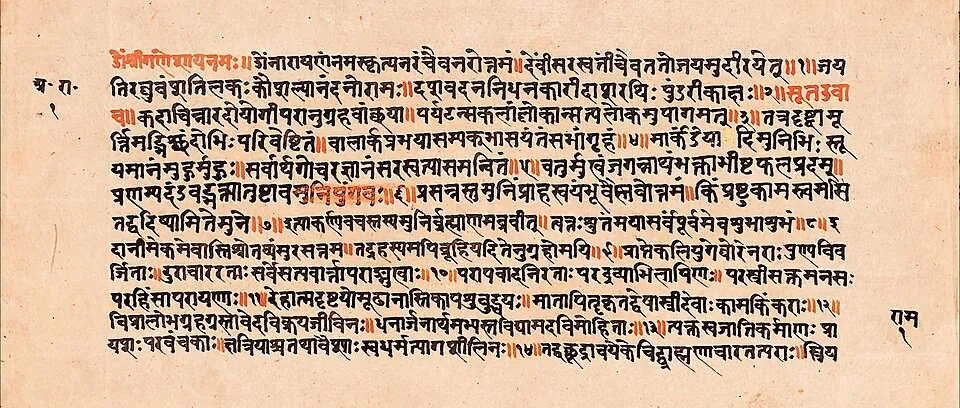
The Brahmanda Purana is traditionally listed last among the eighteen Mahapuranas. Its title refers to the Brahmanda, the egg-shaped universe in Hindu cosmological thought. Medieval writers sometimes called it the Vayaviya Purana, and it was probably once closely bound up with the Vayu Purana before the two grew into separate, overlapping works. Scholars place the oldest layer of material around the fourth century CE, although the text was revised for many centuries and survives in numerous versions, so any single date is only a rough marker for when the work began to take shape. The manuscripts are encyclopedic. They cover cosmogony, the sacraments, genealogies of kings and sages, ethics and duty, yoga, geography and rivers, statecraft and trade, festivals, and even something like a traveller's guide to places such as Kashmir, Cuttack and Kanchipuram. The Purana is especially known for the Lalita Sahasranama, a thousand-name hymn to the goddess Lalita, and for a hymn to Radha. It also contains the Adhyatma Ramayana, an embedded retelling that reads the story through a philosophical lens. A form of the text travelled to Bali, where it became part of local literature.
Sources
- Brahmanda Purana Wikipedia · CC-BY-SA-4.0
- Q975973 Wikidata · CC0-1.0