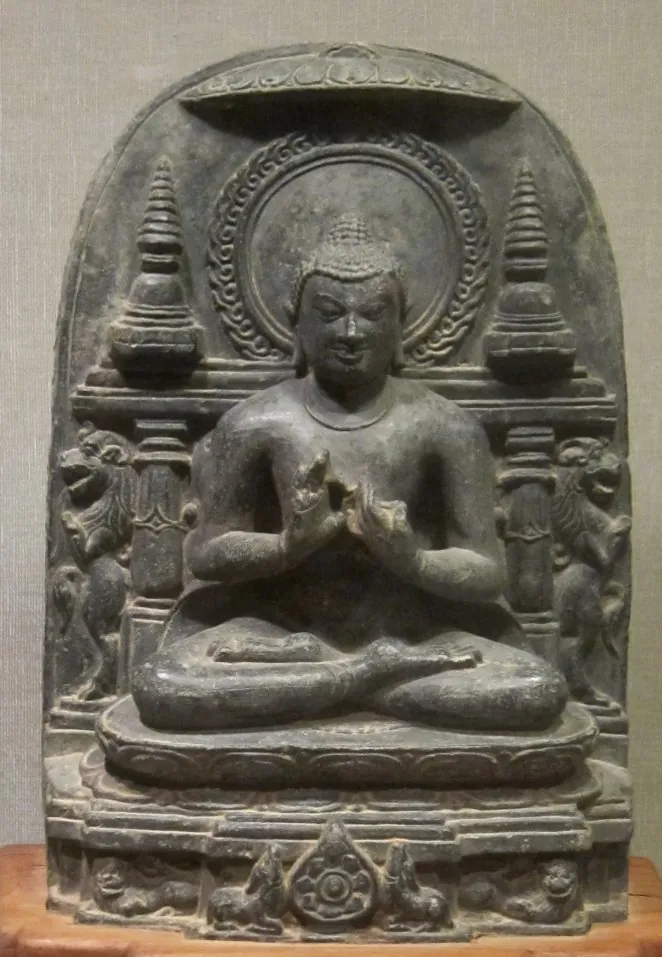
Aśvaghoṣa Composes the Buddhacarita
Buddhacarita · बुद्धचरितम्
The Buddhacarita, 'Acts of the Buddha', is a Sanskrit mahākāvya about Gautama Buddha's life, composed by Aśvaghoṣa of Sāketa in the early second century CE. Only the first fourteen of its twenty-eight cantos survive in Sanskrit, though Chinese and Tibetan versions preserve the whole.
The Buddhacarita is a Sanskrit court epic, a mahākāvya, narrating the career of Gautama Buddha. Its author, Aśvaghoṣa, hailed from Sāketa, today's Ayodhyā, and composed it in the early second century CE. His account differs from older biographies such as the Mahāvastu and the Lalitavistara by being artistically arranged and restrained in how it presents the Buddha's miracles. The poet clearly knew Indian myth and the older philosophies, and he writes with a courtier's eye for romance, battle and kingship, so that the prince's renunciation is set against vivid scenes of palace life. Of its twenty-eight cantos, the first fourteen survive in Sanskrit, while cantos fifteen to twenty-eight exist only in incomplete form. The Chinese translation of the fifth century, made by Dharmakṣema in 420 CE, and a Tibetan translation of the seventh or eighth century preserve all twenty-eight chapters. The work is important both as a landmark of classical Sanskrit poetry, a forerunner of Kālidāsa, and as a witness to how Buddhist tradition told the story of its founder.
Sources
- Buddhacharita Wikipedia · CC-BY-SA-4.0
- Q2280431 Wikidata · CC0-1.0