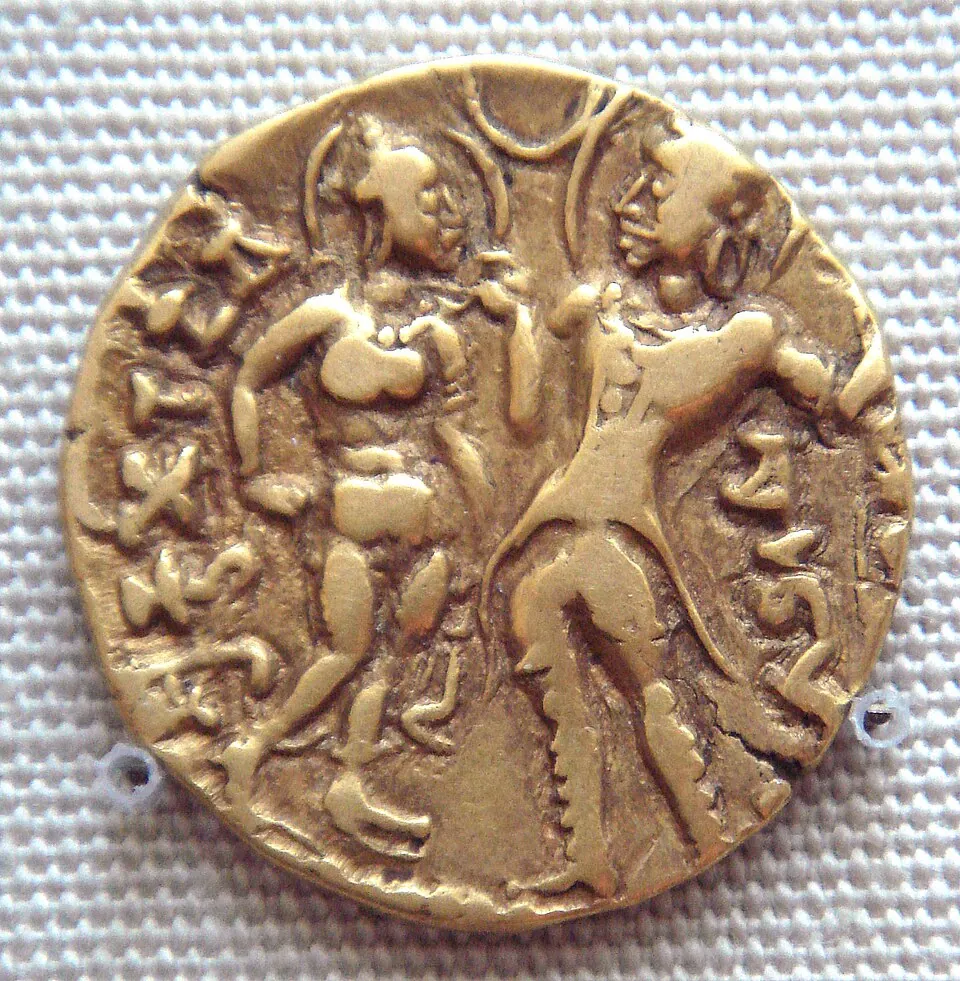
Chandragupta I Takes the Title Mahārājādhirāja
Chandragupta I, reigning about 319 to 335 CE, appears to have been the first Gupta ruler to hold the imperial title Mahārājādhirāja. Historians often credit his marriage to the Licchavi princess Kumāradevī with enlarging his power, which his son Samudragupta then carried much further.
Chandragupta I ruled the Gupta realm in northern and central India from about 319 to 335 CE. The imperial title Mahārājādhirāja, which translates as king of great kings, hints that he was the earliest of his line to rule as a sovereign over lesser chiefs. How a small ancestral kingdom grew under him into a larger state is not certain from the surviving record. A theory widely accepted by modern historians holds that his marriage to Kumāradevī, a princess of the Licchavi clan, brought political strength and extended his reach, since the Licchavis were a well-regarded power in the Ganges region. Coins and later inscriptions refer to the alliance with notable prominence. His son Samudragupta inherited the realm and expanded it greatly, so that the dynasty came to dominate much of the subcontinent in the following generations. Chandragupta I is therefore often seen as the founder of the Gupta imperial tradition, even though the lasting expansion belongs to his successors. His name is also a reminder of the earlier Maurya emperor Chandragupta, with whom he should not be confused.
Sources
- Chandragupta I Wikipedia · CC-BY-SA-4.0
- Q849802 Wikidata · CC0-1.0