Samudragupta Builds a Gupta Empire
Samudragupta · समुद्रगुप्त
Samudragupta, son of Chandragupta I and the Licchavi princess Kumāradevī, ruled in the fourth century and turned the Gupta kingdom into a vast empire. The Allahabad Pillar eulogy, composed by Harisena, records his northern conquests and a southern march to Kanchipuram.
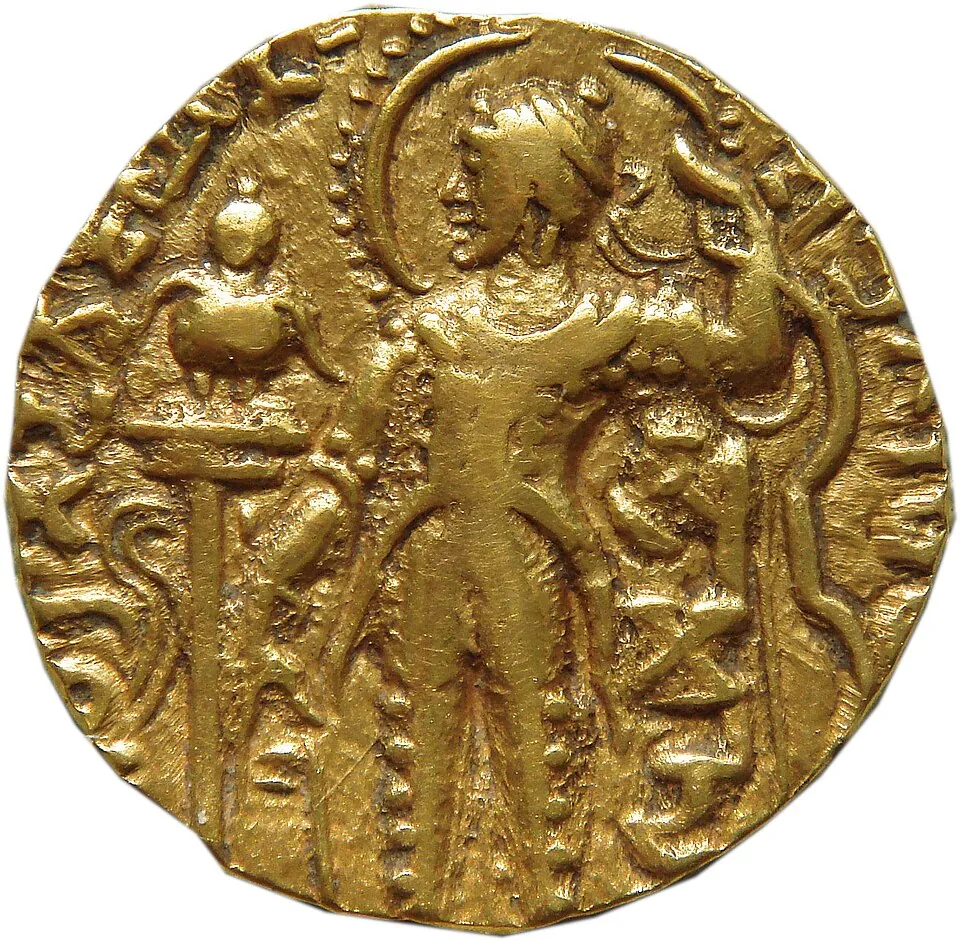
Samudragupta was the Gupta Empire's second emperor, and traditional dates place his life at 318 to 375 CE. He was the son of Chandragupta I and the Licchavi princess Kumāradevī, and he inherited a modest kingdom, which he expanded into a large empire by waging campaigns. Our main evidence is the Allahabad Pillar inscription, a prashasti or eulogy written by his court poet Harisena. It credits him with defeating several kings of northern India and absorbing their lands. It also describes a march along the south-eastern coast as far as Kanchipuram, in the Pallava country, where he defeated local rulers but left them in place as tributaries. Other frontier states and tribal republics acknowledged his authority by paying tribute and offering homage. Because the inscription was a royal panegyric, historians read its claims with some caution. His reign nonetheless laid the foundation for the prosperous age of his successors, and his gold coins, some showing him playing the veena, point to a ruler who valued the arts.
Sources
- Samudragupta Wikipedia · CC-BY-SA-4.0
- Q1133363 Wikidata · CC0-1.0