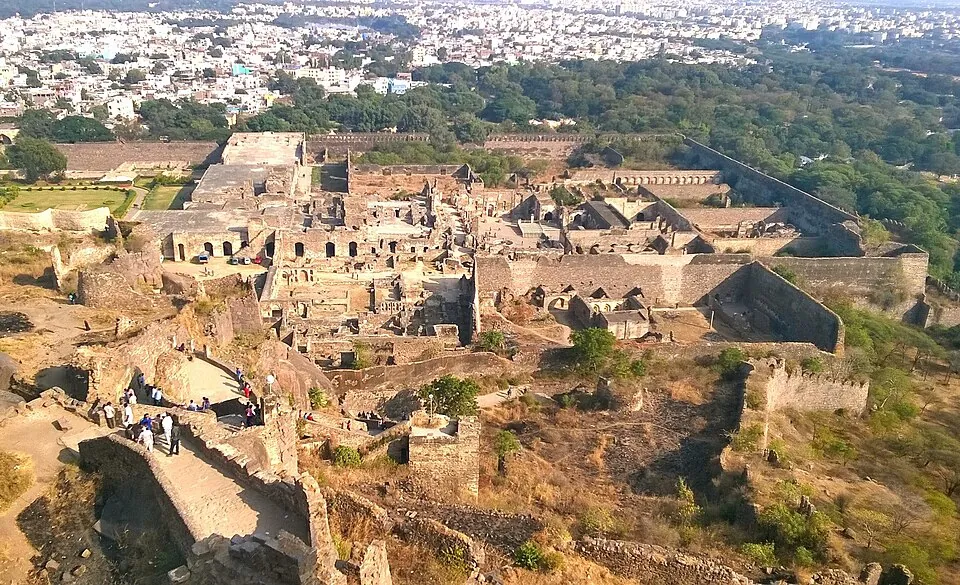
Golconda Becomes a Qutb Shāhī Citadel
Golkoṇḍā · गोलकोण्डा
Golconda, west of modern Hyderabad, began as an earthen fort and became a great stone citadel under the Qutb Shāhī dynasty, who ruled from about 1518. Famed for its walls, acoustics and diamond trade, it was the dynasty's capital until the move to Hyderabad and fell to Aurangzeb in 1687.
Golconda, once also named Muḥammadnagar, is a ruined walled city and citadel on Hyderabad's western outskirts, in Telangana. The earliest fort was an earthen one built by the Kākatīya rulers, and it later passed to the Bahmanī sultans, before the Qutb Shāhī family, who had begun as Bahmanī governors, became independent and turned it into a mighty stone fortress. Sultan Qulī Quṭb al-Mulk led the dynasty from about 1518, and he and his successors raised the granite walls, gateways and palaces we see today. The fort became famous for its engineering, including a clever acoustic design in which a hand clap at the entrance can be heard at the summit, and for its water supply system. It stood at the centre of a thriving trade in diamonds from the mines of the region, and its name became a byword for riches. The Qutb Shāhīs moved their capital to the new city of Hyderabad in 1591, but the fort remained a stronghold until it was captured by the Mughal emperor Aurangzeb after a long siege in 1687.