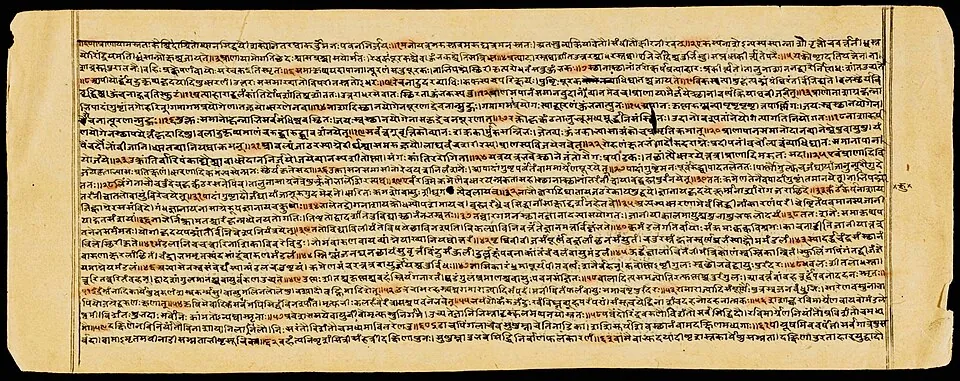
The Jain Āgamas, Canon of an Oral Tradition
Jaina Āgama · जैन आगम
The Jain Āgamas are the canonical scriptures of Jainism, composed in Ardhamāgadhī Prākrit and passed on orally before being written down. The Digambara and Śvetāmbara orders differ over which texts are authoritative, and later monks added many commentaries. Later monks added many commentaries.
Jain literature began as an oral tradition, and its oldest surviving core is the body of canonical works called the Āgamas. They are written in Ardhamāgadhī, a Middle Indo-Aryan Prākrit, and record the teachings attributed to Mahāvīra and his early followers. Over centuries the texts were memorised by monks, and the process of fixing and eventually writing them down took place in several stages, with councils at Pāṭaliputra and, much later, at Valabhī. Jain sources trace the first attempt at assembling the teaching to the time of the Mauryan empire, so the year used here, about 300 BCE, is an approximate scholarly marker for that phase. The two main orders do not agree on which works carry authority. The Śvetāmbaras accept a canon of surviving Āgamas, while the Digambaras hold that the original texts were lost and rely on other early works. Later monks produced many commentaries, and Jain writers went on to compose in Sanskrit, Maharashtri Prākrit and, eventually, Kannada, Tamil, Gujarati, Hindi and English. The Āgamas therefore form the starting point of a large literary heritage.
Sources
- Jain literature Wikipedia · CC-BY-SA-4.0
- Q17006151 Wikidata · CC0-1.0