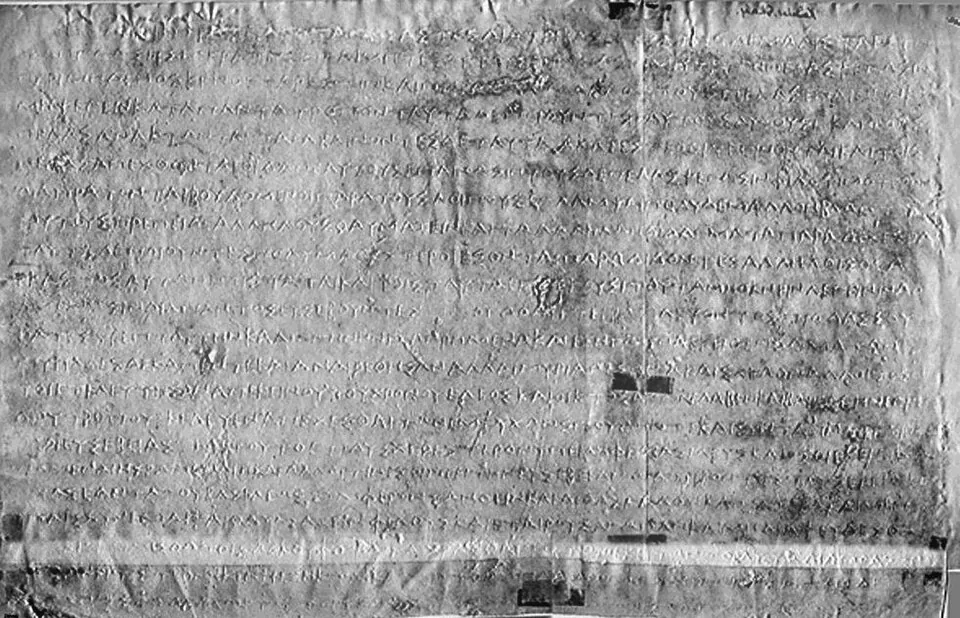
Aśoka's Greek Edict Found at Kandahar
A limestone fragment inscribed in Greek and Prakrit with Major Rock Edicts of Aśoka was found at Old Kandahar in Afghanistan in 1963. Probably part of a building, it is the only Aśokan inscription known from a stone structure. Its present whereabouts are unknown after the Kabul Museum was looted.
Old Kandahar, in Afghanistan, is thought to have been founded in the fourth century BCE by Alexander the Great as Alexandria in Arachosia. There, in 1963, researchers identified a plaque of limestone carrying edicts of the Mauryan emperor Aśoka, who ruled from about 269 to 233 BCE, rendered in Greek and in Prakrit. The slab measures about 45 by 69.5 centimetres and some 12 centimetres in thickness. A German physician named Seyring first acquired it in the Kandahar bazaar, and French archaeologists then established that it had been dug out of the old city. The piece is distinctive: it is the sole Aśokan inscription believed to have belonged to a masonry building rather than a rock face or pillar. Both ends of the text are missing, which suggests the original was far longer and may have set out all fourteen Major Rock Edicts in Greek, as other sites do. The fragment was offered to the Kabul Museum, but its location has been unknown since the museum was plundered between 1992 and 1994.
Sources
- Kandahar Greek Edicts of Ashoka Wikipedia · CC-BY-SA-4.0
- Q27958823 Wikidata · CC0-1.0