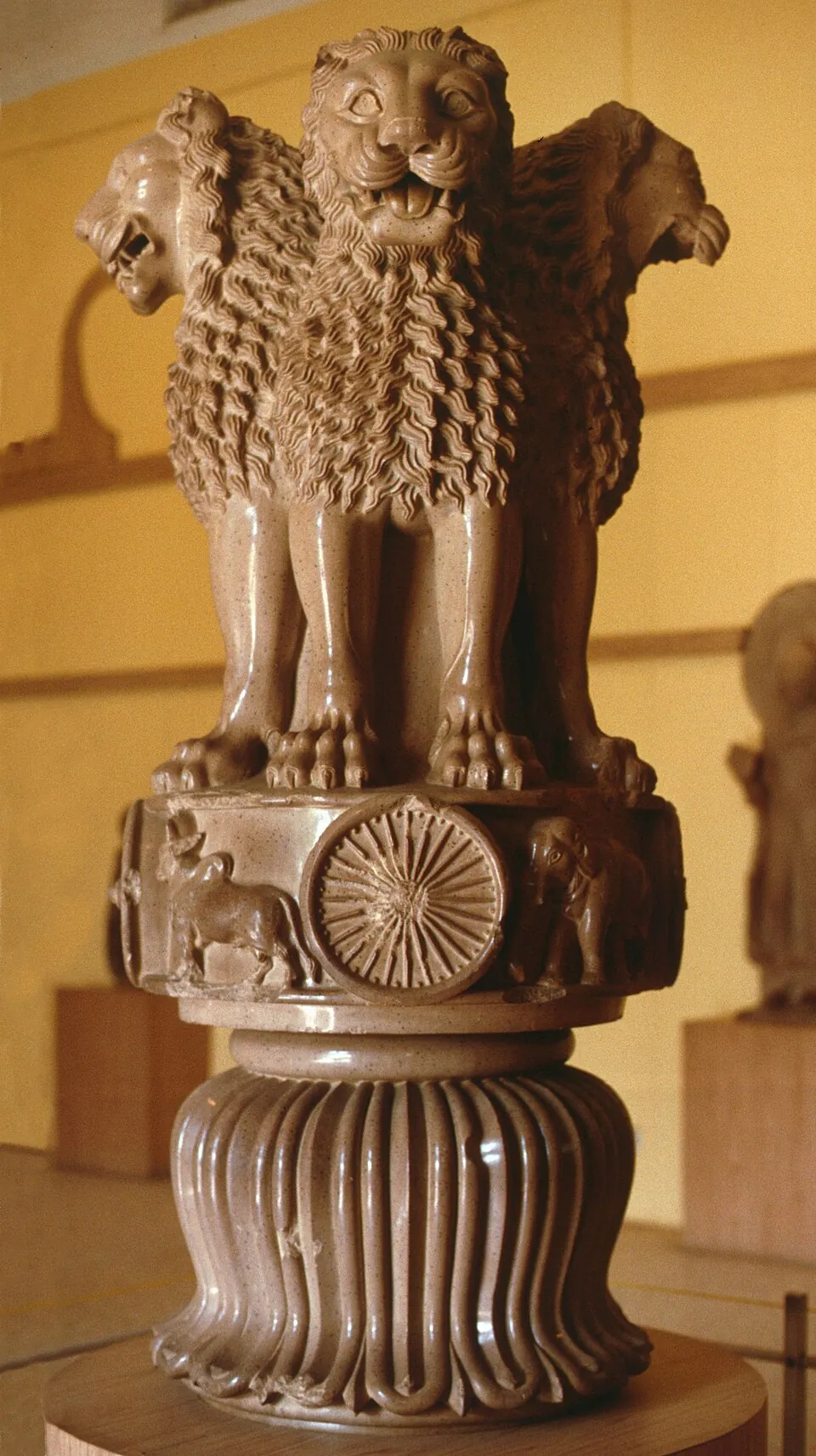
The Lion Capital of Aśoka at Sārnāth
Aśoka Siṃha-stambha · अशोक सिंहस्तम्भ
The Lion Capital, set up around 250 BCE at Sārnāth by the Mauryan emperor Aśoka, shows four lions back to back on a drum carved with a wheel and four animals, all cut from one polished sandstone block. It marks the Buddha's first sermon and later became the emblem of the Republic of India.
Around 250 BCE the Mauryan emperor Aśoka had a pillar raised at Sārnāth, near Vārāṇasī, and crowned it with a capital of great refinement. Four life-size lions sit with their backs together above a round abacus. Four wheels in relief circle the drum, and between them a lion, elephant, bull and galloping horse follow one another from right to left. Below it a bell-shaped lotus forms the base. The whole capital, about 2.1 metres tall, was cut from a single block of sandstone and given a high polish, then fixed to its monolithic shaft with a metal dowel. It was erected after Aśoka's embrace of Buddhism and honours the place where the Buddha gave his first sermon roughly two centuries earlier. In time the capital fell and lay buried until it was excavated by the Archaeological Survey of India in the early twentieth century. It is now displayed in the museum at Sārnāth, and its lions and wheel were adopted for India's national emblem and flag, which gives the monument a living place in modern public life.
Sources
- Lion Capital of Ashoka Wikipedia · CC-BY-SA-4.0
- Q3595955 Wikidata · CC0-1.0