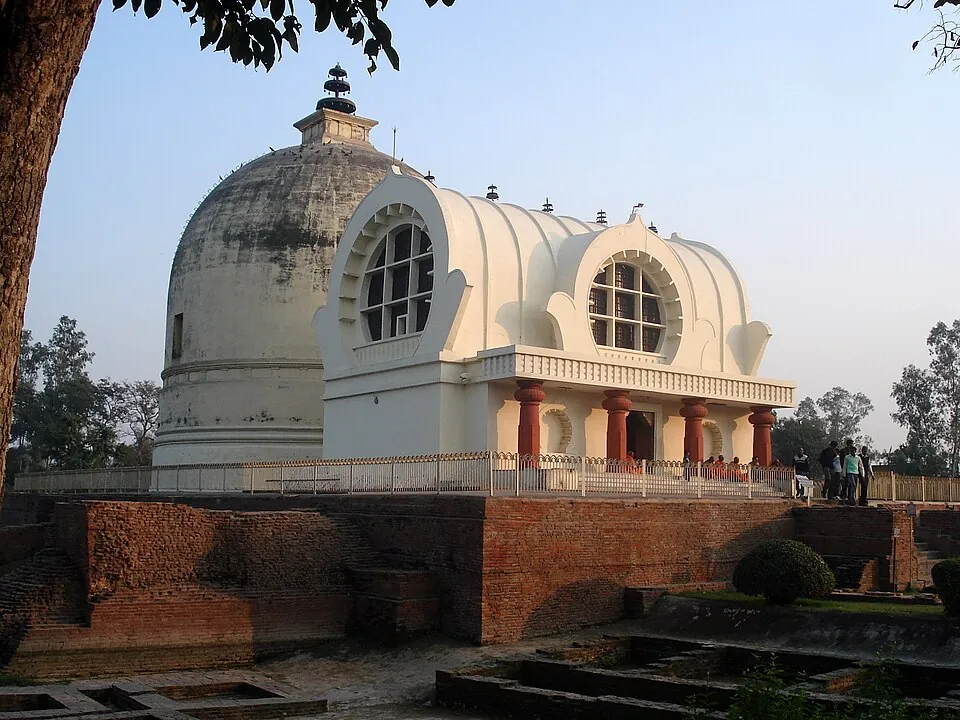
Kuśinagara, Place of the Buddha's Parinirvāṇa
Kuśinagara · कुशीनगर
Kuśinagara, now Kushinagar in Uttar Pradesh, is the Buddhist pilgrimage town where Gautama Buddha is believed to have died and entered parinirvāṇa. Many scholars place the event in the later fifth century BCE, though the exact year is debated. It remains a major pilgrimage destination today.
Kuśinagara, in Pali Kusinārā, is a town in the Kushinagar district of Uttar Pradesh. Buddhist tradition holds that Gautama Buddha attained parinirvāṇa there, the final passing from which no rebirth follows, after a last journey through the Gangetic plain in his eightieth year. The Mahāparinibbāna Sutta recounts that he lay between two sal trees, spoke last words of counsel to his monks, and was cremated by the local Mallas, after which his relics were divided among several claimants and enshrined in stūpas. This made the place one of the four great sites of pilgrimage, along with Lumbinī, Bodh Gayā and Sārnāth. The year of his death is not settled. Many modern scholars once preferred about 480 BCE, while others now argue for a date some decades later, so the figure here is an approximation. The Kuśinagara site later attracted monasteries and shrines, and today visitors travel there from across the Buddhist world. The event is central to Buddhist memory and, for historians, offers one of the anchor points for early Indian chronology.
Sources
- Kushinagar Wikipedia · CC-BY-SA-4.0
- Q825673 Wikidata · CC0-1.0