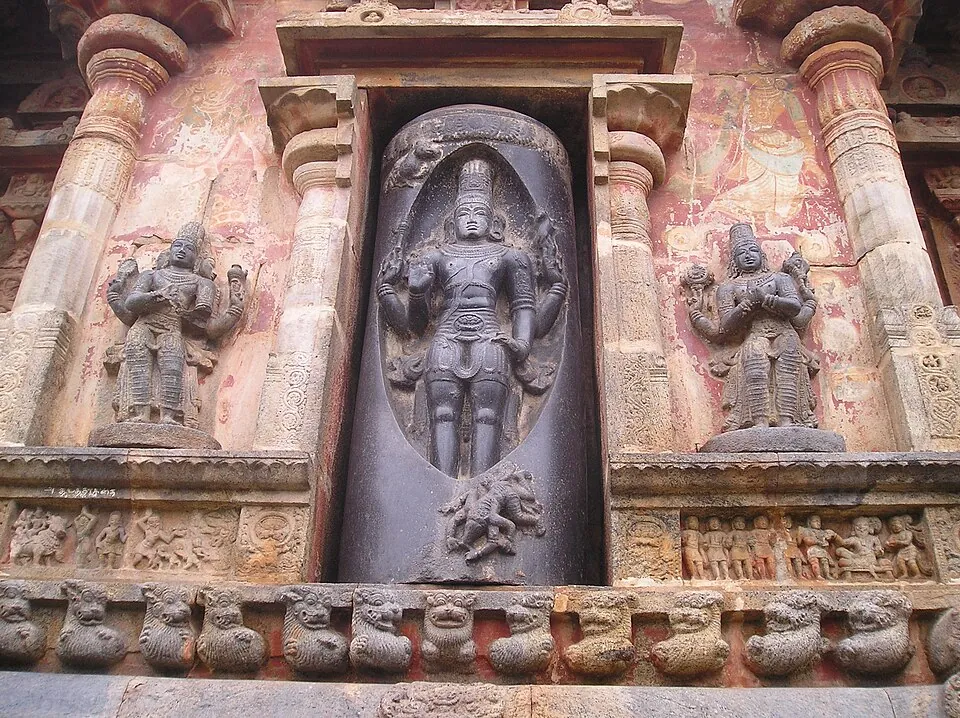
Liṅgodbhava: Śiva Emerges from the Pillar of Light
Liṅgodbhava · लिङ्गोद्भव
Liṅgodbhava, the emergence of the liṅga, is a sculptural form of Śiva rising from a column of light, with Viṣṇu as a boar below and Brahmā as a goose above. Its earliest clear literary evidence comes from seventh-century Tamil Śaiva saints, and it is common in Tamil temples.
Liṅgodbhava is an image type that shows Śiva appearing out of a pillar of light. Smaller figures flank the pillar: Viṣṇu in the form of a boar at the foot and Brahmā as a gander at the top. The icon illustrates a story about the origin of the liṅga, the abstract emblem through which Śiva is often worshipped. Versions of the tale appear across several Purāṇas, and scholars see in it a blending of older cults that venerated pillars. Such carvings are especially visible in the sanctum walls of Tamil Nadu temples, where they are commonly placed in a niche behind the main shrine. The earliest literary evidence for the iconic form lies in the seventh-century hymns of the Śaiva saints Appar and Sambandar. The Tirukkural, a Tamil text often dated about the fifth century, is another hint, though less direct. Because the evidence is literary and the image has no single founding date, the date shown is a broad approximation centred on the seventh century. It should be understood as the earliest attested period for the motif rather than a precise origin.
Sources
- Lingodbhava Wikipedia · CC-BY-SA-4.0
- Q18354205 Wikidata · CC0-1.0