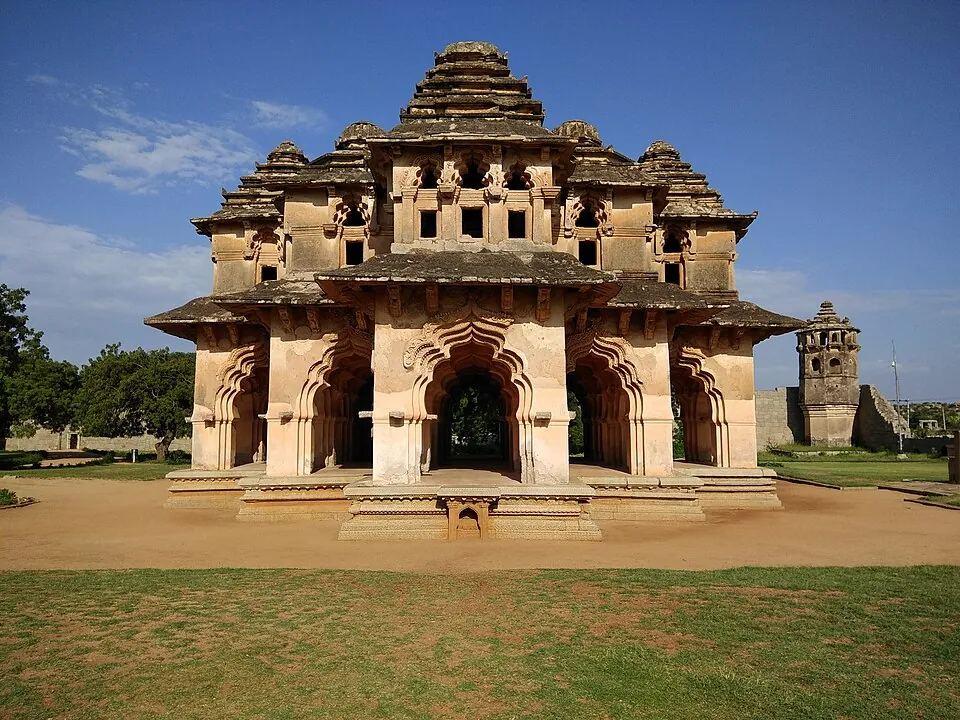
Lotus Mahal, Vijayanagara's Royal Pavilion at Hampi
Kamala Mahal · कमल महल
The Lotus Mahal, also called Chitrāṅgiṇī Mahal, is a two-storeyed secular pavilion in the royal enclosure at Hampi. Built of rubble masonry with fine plaster, it shows the Vijayanagara blending of local and Indo-Islamic styles and is thought to have served the royal family.
The Lotus Mahal, also known as Chitrāṅgiṇī Mahal, is one of the best-preserved secular buildings at Hampi, the capital of the Vijayanagara Empire. It is a two-storeyed pavilion of rubble masonry covered with finely finished plaster, set in the zenana enclosure of the royal centre. The building is taken as a notable example of Vijayanagara architecture, and its arches and decorative stucco show how the empire's builders combined local Dravidian forms with influences from Indo-Islamic design. Its name is usually explained by the symmetrical, lotus-like shape of the upper arches. It is thought to have been used by women of the royal household, as a place for rest and recreation, although the building's original purpose is not recorded in any surviving inscription and is inferred from its setting. The structure is generally dated to the early sixteenth century, so the date used here is approximate. It forms part of the Group of Monuments at Hampi, a UNESCO World Heritage Site that preserves the ruined imperial city.
Sources
- Lotus Mahal Wikipedia · CC-BY-SA-4.0
- Q97440781 Wikidata · CC0-1.0