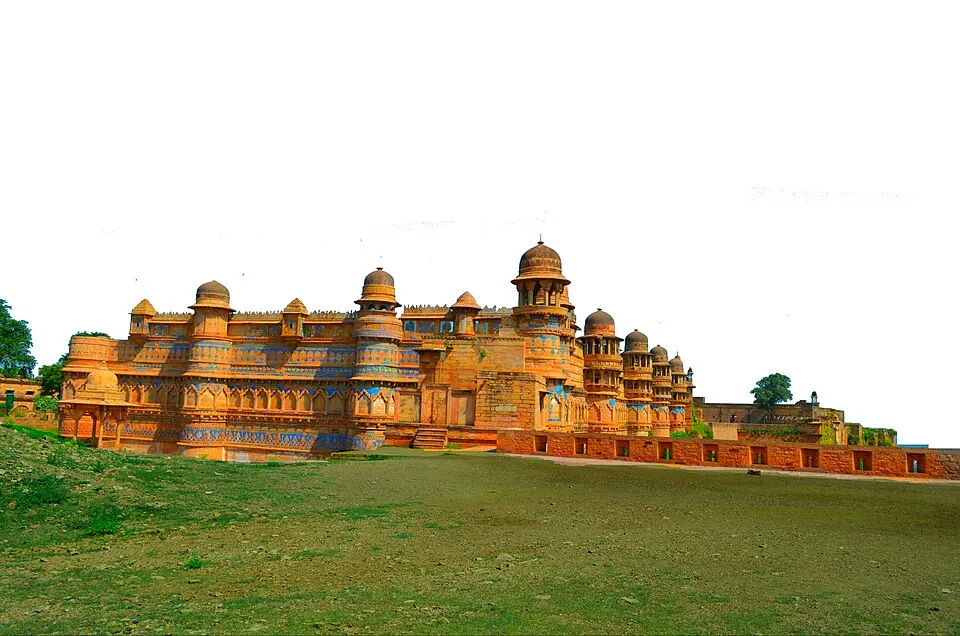
Gwalior Fort and the Tomar Palaces
Gwālior Qilā · ग्वालियर क़िला
Gwalior Fort, a hill fort of at least the sixth-century origins, was greatly enlarged by the Tomar ruler Man Singh in the late fifteenth and early sixteenth centuries. Its palaces and its Chaturbhuj temple inscription, with an early place-value zero, make it a landmark of Indian heritage.
Gwalior Fort rises on a sandstone hill and is among India's oldest defensive works. Ancient Sanskrit inscriptions call it Gopagiri, and records suggest it may have existed from the early sixth century, with the present structure standing from at least the eighth. The Mughal emperor Bābur praised it as a pearl among the fortresses of Hind. The complex today has a defensive circuit and six palaces, two of which were commissioned by the Tomar king Man Singh, who reigned from 1486 to 1516: the Man Mandir and the Gūjarī Mahal, the latter built for his wife Mṛgnayanī. The fort passed through many hands, including the Pratihāras, Tomaras, sultanate rulers, Sūrs, Mughals, the English, Jats and the Scindias. An inscription on the Chaturbhuj Temple, sometimes called the Zero Temple, records an early use of the numeral zero with place value, second in antiquity only to the Bakhshali manuscript. The date used here marks the fort's most significant architectural expansion under the Tomars, at the end of the fifteenth century.
Sources
- Gwalior Fort Wikipedia · CC-BY-SA-4.0
- Q2487545 Wikidata · CC0-1.0