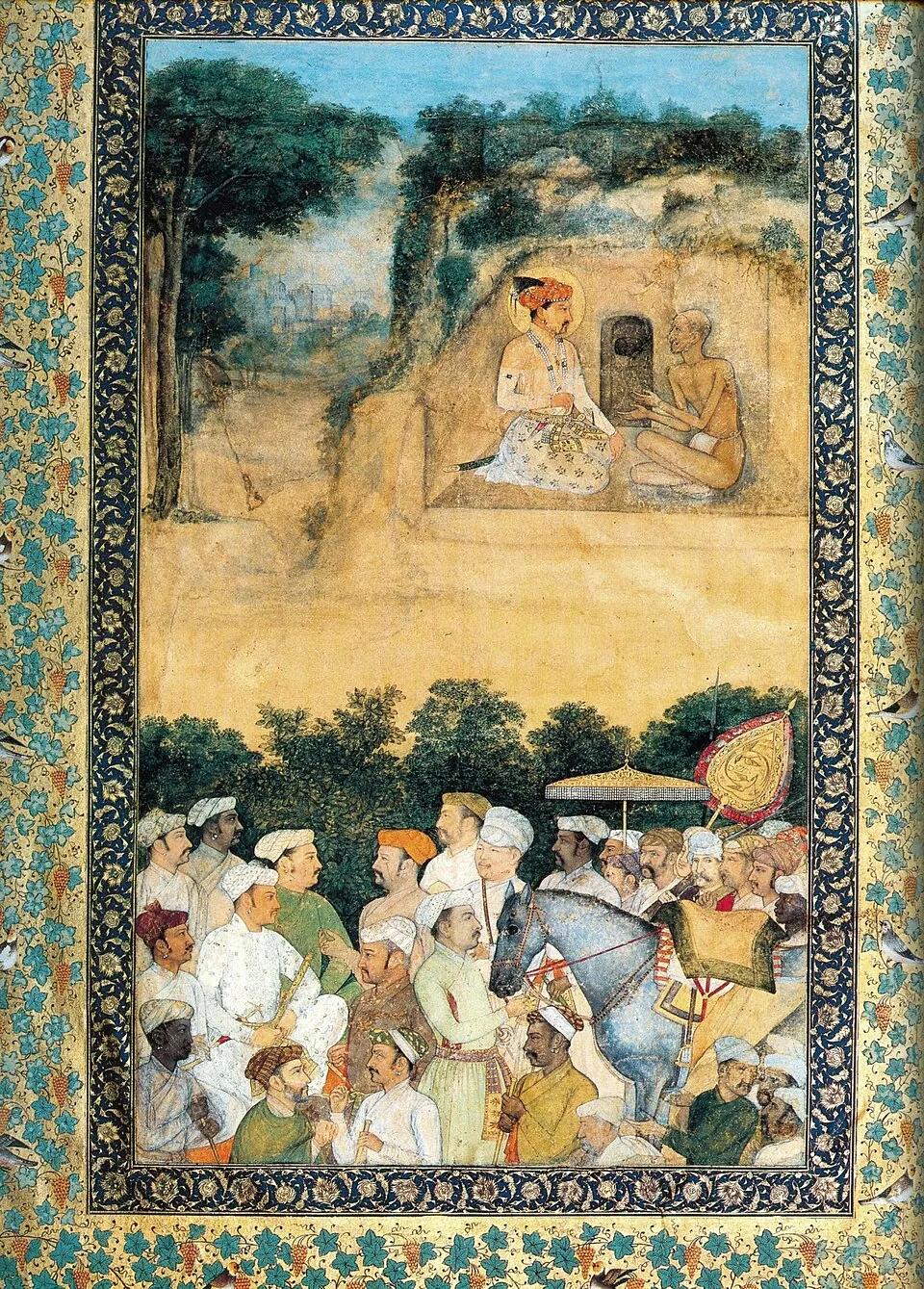
Mughal Painting Emerges at Court
Mughal Citrakalā · मुग़ल चित्रकला
Mughal painting is a style of miniature, made for book illustrations and album pages, that developed under the Mughal emperors from the sixteenth century. It grew from Persian miniature, took in Indian and Islamic elements, and produced court portraits, historical scenes and natural studies of unusual precision.
Mughal painting is a school of miniature painting, produced either to illustrate books or as single works collected in albums known as muraqqa. It arose during the Mughal period and developed from the Persian miniature tradition, itself shaped by Chinese and, later, European art. Indian and Islamic influences were added in the new setting. The emperor Humāyūn brought Persian masters, notably Mīr Sayyid ʿAlī and ʿAbd al-Ṣamad, to his court, and under Akbar the imperial workshop grew into a large studio where Persian and Indian artists worked together, producing great illustrated manuscripts such as the Ḥamzanāma and the Akbarnāma. Under Jahāngīr the emphasis moved towards the portrait, the careful study of birds, animals and flowers, and a refined naturalism, and under Shāh Jahān the style became formal and elegant. Painting declined after the early eighteenth century as court patronage waned, but its influence continued in regional schools, including the Rajput and Pahari courts. The tradition left an exceptional visual record of the court, its people and its world, and it shows how artistic exchange shaped Indian culture in the early modern age.
Sources
- Mughal painting Wikipedia · CC-BY-SA-4.0
- Q1049336 Wikidata · CC0-1.0