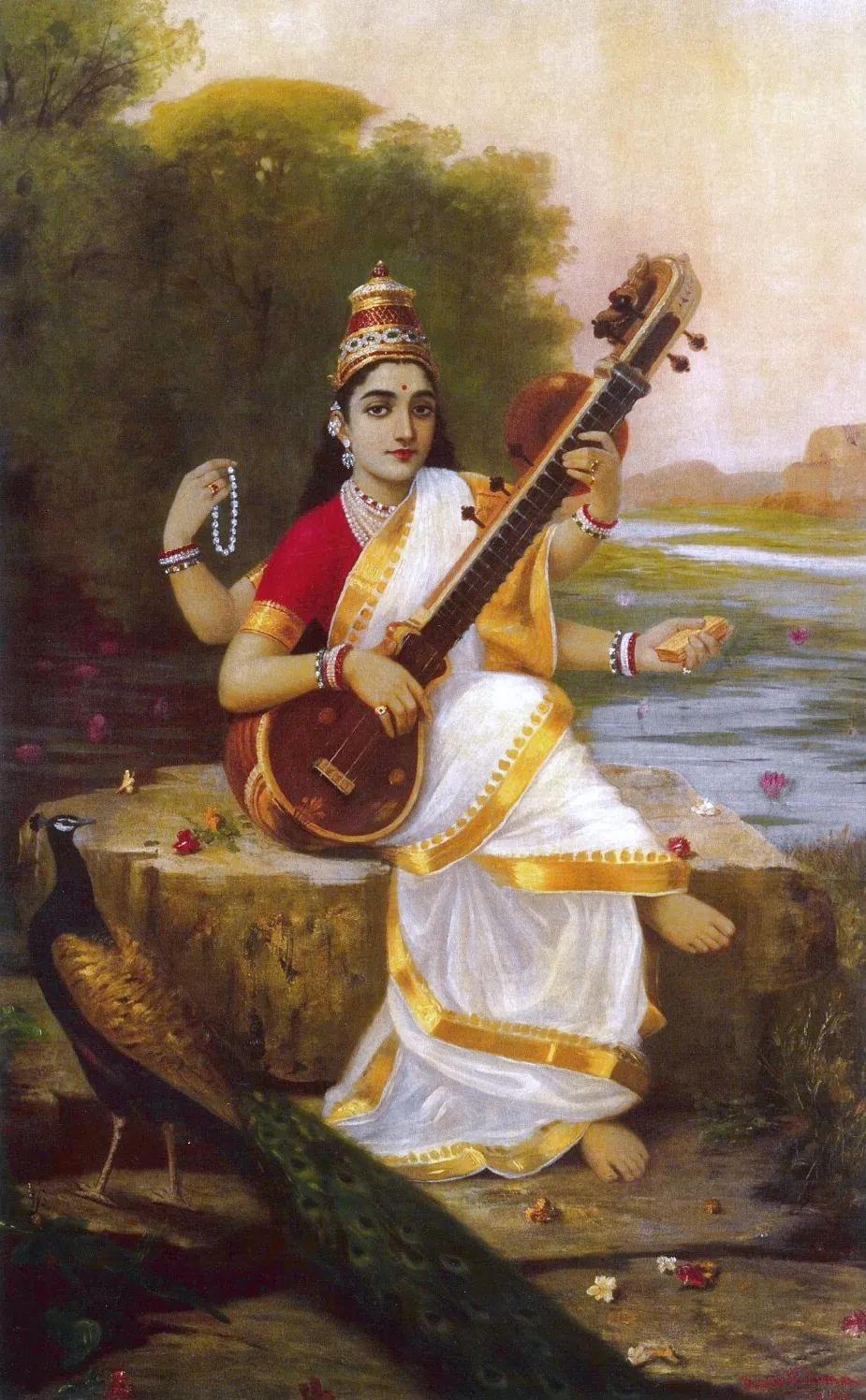
Sarasvatī, Goddess of Speech and Learning
Sarasvatī · सरस्वती
Purāṇic narrative set in cosmic time; not dated history.
Sarasvatī is among the principal goddesses of Hinduism, honoured as patron of knowledge, speech, music and the arts. Beginning as a Vedic river deity, she merged with the goddess of speech, Vāc, and in later tradition is linked to Brahmā. She is also revered in Jain and Buddhist settings.
Sarasvatī belongs to the Tridevi, the triad of great goddesses that also includes Lakṣmī and Pārvatī. Her roots lie in the Vedic hymns, where she is celebrated as a river whose waters purify and bring fertility, making her one of the oldest river goddesses in Indian religion. In later Vedic literature, especially the Brāhmaṇas, she is increasingly identified with Vāc, the divine personification of speech, and the two figures gradually become one. As the river's role fades from devotion, her association with eloquence, poetry, music and scholarship grows stronger. Classical and medieval Hindu writers present her as the source of learning and artistic inspiration, and some credit her with inventing the Sanskrit language. Narratives connect her with Brahmā, either as his creation or as his consort. Her worship is not confined to one community: Jain and Buddhist traditions also honour a goddess of wisdom and speech. Students and artists across the subcontinent invoke her, notably at the start of study. The date given reflects Purāṇic cosmic time rather than a historical event.