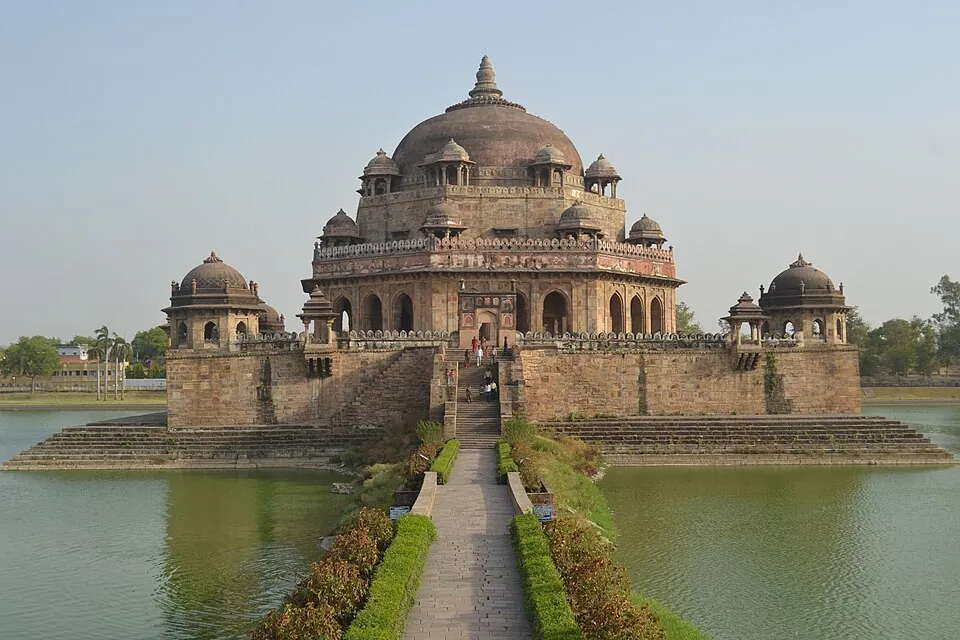
Sher Shah's Mausoleum Completed at Sasaram
The tomb of Sher Shah Suri at Sasaram in Bihar was finished in August 1545, a few months after his death, and rises from a platform amid a man-made lake. A three-storeyed octagon of sandstone under a great dome, it was then the largest mausoleum in India.
The tomb of Sher Shah Suri, founder of the Sur Empire, stands at Sasaram in Bihar and was finished on 16 August 1545, roughly three months after the ruler died. He had commissioned it for himself. The building sits on a square platform at the centre of a man-made lake, reached by a causeway, and is made of sandstone whose surfaces were originally brightly painted and faced with glazed tilework. It is an octagonal structure of three storeys topped by a large dome, with small pavilions called chhatris at each corner of the upper levels and a veranda running all round, each side pierced by three arches. Latticed windows admit light to the interior. Entrances face every direction but west, where the qibla wall holds an elaborately carved and tiled prayer niche. When it was completed it was the largest mausoleum in the country, and it is regarded as a significant example of Indo-Islamic architecture that mixes Afghan tomb traditions with local features. The monument brings together memory of a ruler whose reign was short but administratively influential, and it remains a notable landmark of eastern India.
Sources
- Tomb of Sher Shah Suri Wikipedia · CC-BY-SA-4.0
- Q7818641 Wikidata · CC0-1.0