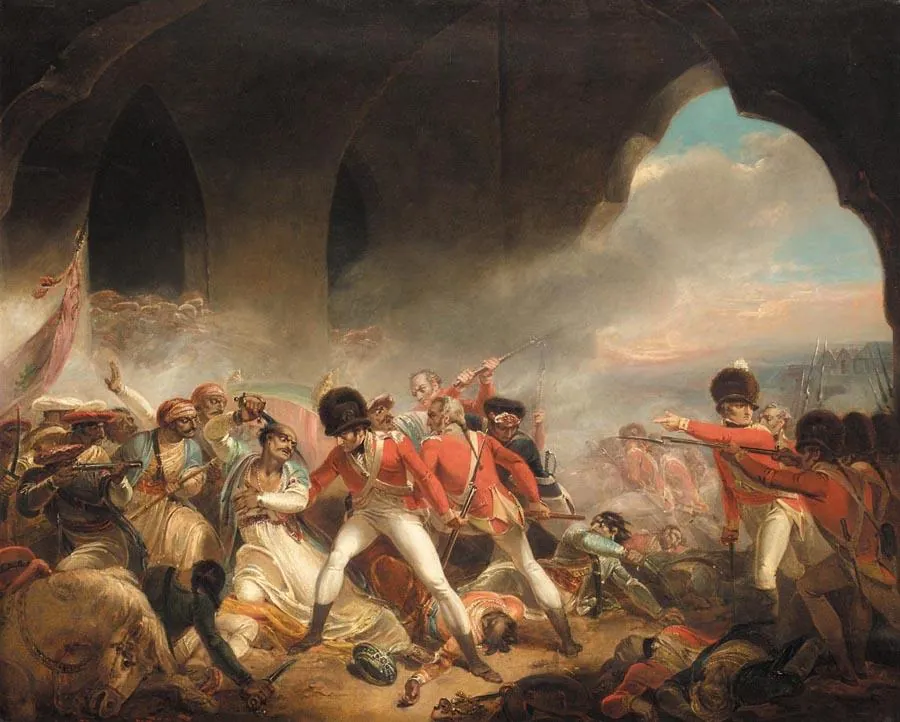
The Fall of Seringapatam and Tipu Sultan
Śrīraṅgapaṭṭaṇa · ಶ್ರೀರಂಗಪಟ್ಟಣ
The siege of Seringapatam, from 5 April to 4 May 1799, ended the Fourth Anglo-Mysore War. British forces, joined by the Nizam of Hyderabad and the Marathas, breached the walls and stormed the citadel, and Tipu Sultan died in the fighting, which opened Mysore to British control.
The siege of Seringapatam lasted from 5 April to 4 May 1799 and was the final clash of the Fourth Anglo-Mysore War, pitting the East India Company of Britain against Mysore under Tipu Sultan, who had ruled since the death of his father Haidar Ali. The Company's army, supported by allies in the form of the Nizam of Hyderabad, Nizam Ali Khan, and the Maratha Empire, advanced on Tipu's island capital at Srirangapatna, set up batteries and, after weeks of bombardment, broke through the fortress walls. Troops then stormed the citadel. Tipu was killed in the fighting on 4 May, and his death ended the war and effectively the independent power of Mysore. The British restored the Wodeyar dynasty, a young prince, to the throne under a subsidiary arrangement, while territory was divided among the victors. Among the officers present was Arthur Wellesley, the future Duke of Wellington. The campaign removed the most determined opponent of Company expansion in the south, and it strengthened the British position in India. For many Indians Tipu remains a symbol of resistance, though he is also judged critically for aspects of his rule.
Sources
- Siege of Seringapatam (1799) Wikipedia · CC-BY-SA-4.0
- Q815204 Wikidata · CC0-1.0