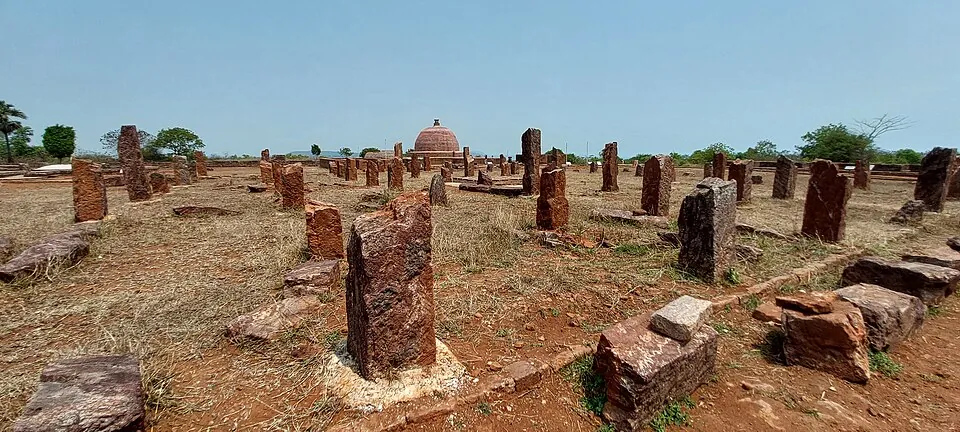
Thotlakonda, a Buddhist Hilltop Monastery by the Sea
Toṭlakoṇḍa · తొట్లకొండ
Thotlakonda is a Buddhist monastic complex on a hill near Bheemunipatnam, close to Visakhapatnam in Andhra Pradesh. It overlooks the sea, and its cisterns gave it its name. Its activity is broadly dated from about the third century BCE onward.
Thotlakonda lies on a hill about 15 kilometres from Visakhapatnam in Andhra Pradesh, near Bheemunipatnam, rising roughly 128 metres above sea level with a view over the ocean. The Telugu name is thought to come from the many rock-cut cisterns hewn into the bedrock, since the word can be understood as the hill of cisterns. The complex is a Buddhist monastery, with stupas, a chaitya hall, monastic cells and assembly halls, and excavations have recovered coins, pottery and inscriptions. Scholars generally date its earliest use to around the third century BCE, in the period of Ashoka's influence on Kalinga, with occupation continuing into the early centuries CE. The date here is approximate. The region lay within the sphere of Kalinga, which was an important point of spread for Buddhism to Sri Lanka and Southeast Asia, and the site was probably a port of arrival for pilgrims coming by sea, travelling to the Buddhist centres near the eighty-third meridian east. Its history therefore sheds light on the movement of Indian culture across the ocean. The main stupa was partly damaged by monsoon rains in 2019, and conservation work restored it by 2021 at a cost of 42 lakh rupees.
Sources
- Thotlakonda Wikipedia · CC-BY-SA-4.0
- Q7796914 Wikidata · CC0-1.0