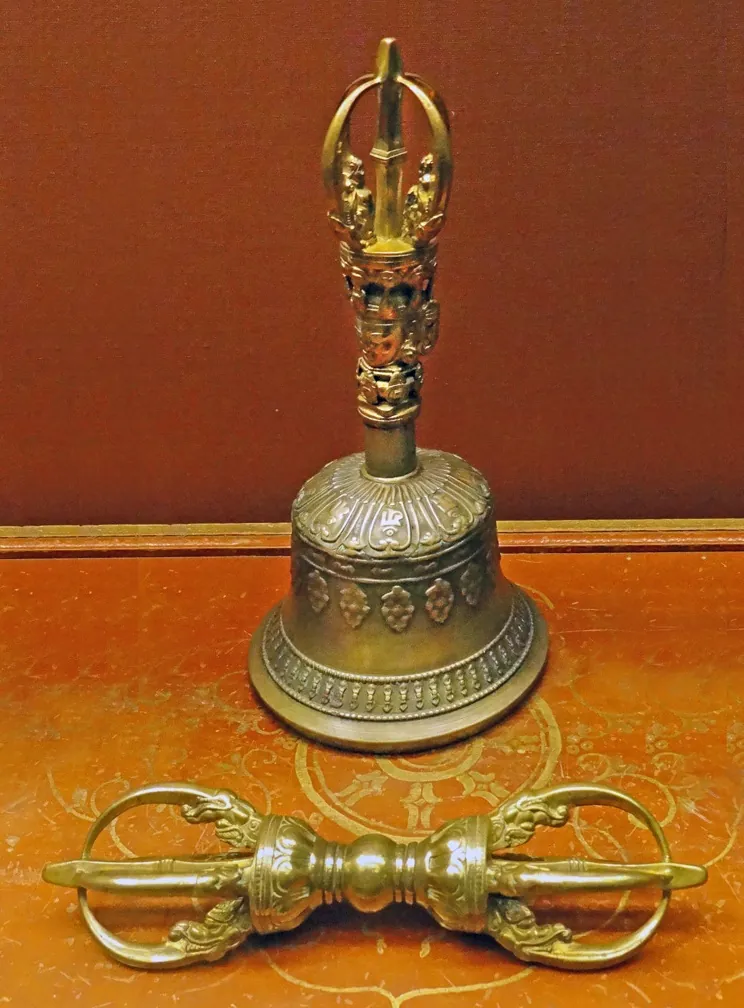
The Rise of Vajrayāna Buddhism
Vajrayāna · वज्रयान
Vajrayāna, the 'Diamond Vehicle', emerged in medieval India between the fifth and seventh centuries CE as a branch of Mahāyāna Buddhism using mantras, mandalas, visualisation and initiation to pursue rapid awakening. Its teachings later shaped Tibetan and wider Himalayan Buddhism.
Vajrayāna, also called Mantrayāna or Tantric Buddhism, developed within the Mahāyāna tradition between roughly the fifth and seventh centuries CE in India. It offers a path of esoteric methods intended to bring awakening more quickly. These methods include mantras, dhāraṇīs, hand gestures called mudrās, mandalas and the imaginative visualisation of Buddhas and deities, and they are understood as ways of turning ordinary experience, even desire and aversion, into a route to liberation. A distinctive feature is transmission by initiation: teachings pass directly from a guru, or vajrācārya, to a student. Followers hold that this lineage reaches back to the historical Buddha, sometimes via other Buddhas or bodhisattvas such as Vajrapāṇi, which they see as guaranteeing the purity of the teaching. Deity yoga, in which a practitioner meditates on a chosen deity, is central. Monastic centres in eastern India were important for these developments, and the tradition was carried to Tibet, Nepal and East Asia. The date here is a broad estimate for when the movement became established, not the origin of a single event.