Aihoḷe Praśasti Praises Pulakeśin II
Aihoḷe Praśasti · ಐಹೊಳೆ ಪ್ರಶಸ್ತಿ
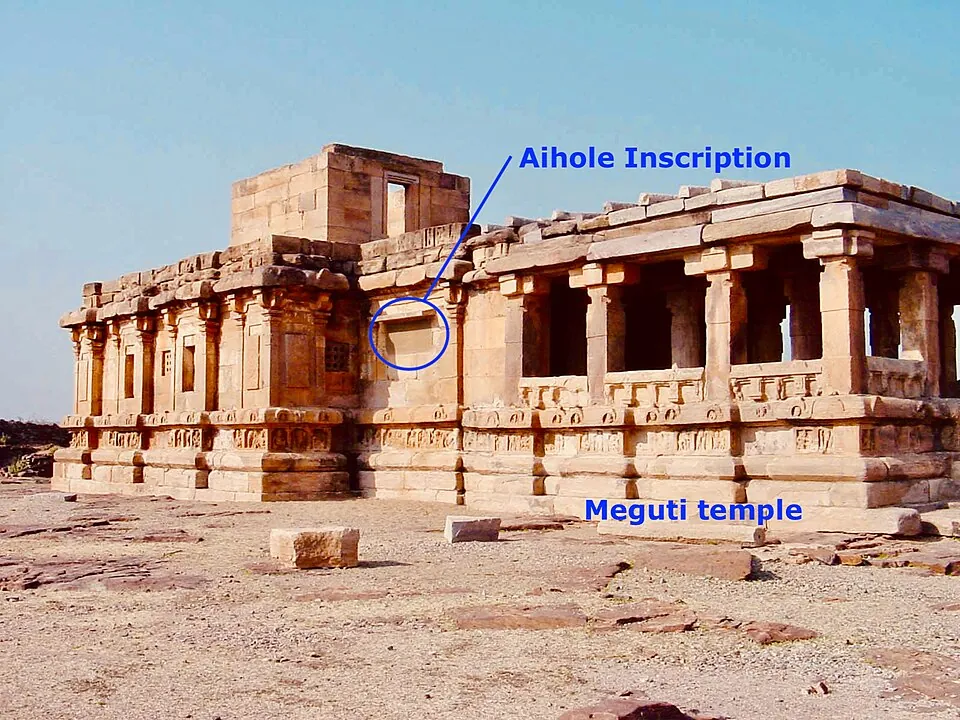
The Aihoḷe inscription is a nineteen-line Sanskrit eulogy dated 634 or 635 CE, composed by the Jain poet Ravikīrti for the Chalukya emperor Pulakeśin II. Carved at the Meguṭi Jain temple in Karnataka, it is a central source for the dynasty's history and for dating Sanskrit literature.
The Aihoḷe inscription, also called the Aihoḷe praśasti, is a nineteen-line Sanskrit text on a stone at the Meguṭi Jain temple in Aihoḷe, Karnataka. It is a panegyric dated to 634–635 CE and was composed by the Jain poet Ravikīrti to honour his patron, the Chalukya emperor Pulakeśin II Satyāśraya of Vātāpi. The record is partly damaged, and its final two lines were added later. Since the 1870s it has been recorded several times, revised, and translated by scholars such as Fleet and Kielhorn. Its value lies in the mix of historical detail and myth. It narrates the rise of the early Chalukyas and the military successes of Pulakeśin II, and has been the subject of much scholarly debate on points of interpretation. It is also important for dating Sanskrit literature, since it names the great poets Kālidāsa and Bhāravi and thereby shows that their works must have been completed before 634. For historians of India it is thus a rare firmly dated reference point in the seventh century, helping to calibrate the chronology of kings, poets and events across the subcontinent.
Sources
- Aihole inscription Wikipedia · CC-BY-SA-4.0
- Q4696876 Wikidata · CC0-1.0