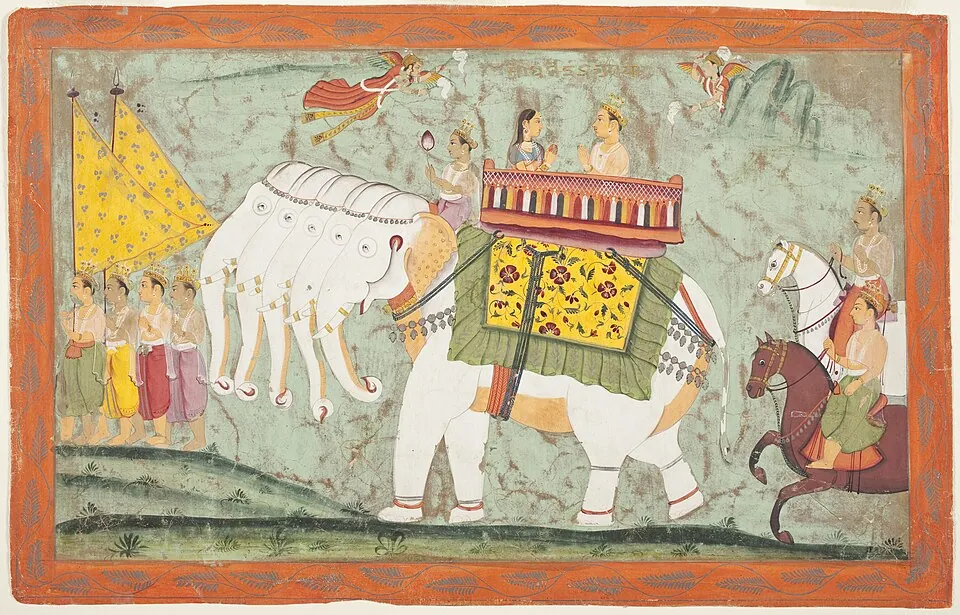
Airāvata, the White Elephant of Indra
Airāvata · ऐरावत
Traditional Purāṇic cosmic reckoning, as for the churning of the ocean; not dated history.
In Hindu sacred texts Airāvata is a divine white elephant, sovereign of elephants, and the chief mount of Indra. Texts picture him with triple heads, six tusks and triple trunks, while some Purāṇas give him ten tusks. He bears epithets such as Abhramātaṅga, the elephant of the clouds.
Airāvata is a divine elephant of Hindu tradition whose name means belonging to Irāvatī. In Pāli he is called Erāvaṇa and in Sinhala Airāvaṇa. According to sacred Hindu texts, his birth is described as bringing three heads, six tusks and three trunks, with a dazzling white body. Some Purāṇas instead give him ten tusks and five trunks, standing for the ten directions. He is styled sovereign of elephants and is the chief mount of the deity Indra. His other names include Abhramātaṅga, the elephant of the clouds, Nāgamalla, the fighting elephant, and Arkasodara, the brother of the sun. His wife among elephants is named Abhramu. He is also described as the third son of Irāvatī, and the Mahābhārata lists him as a great serpent. In the Purāṇic narrative he is associated with the churning of the ocean. The entry belongs to the sacred and cosmological narrative of the Purāṇas, so the very remote date used here is a traditional marker and not a historical one.