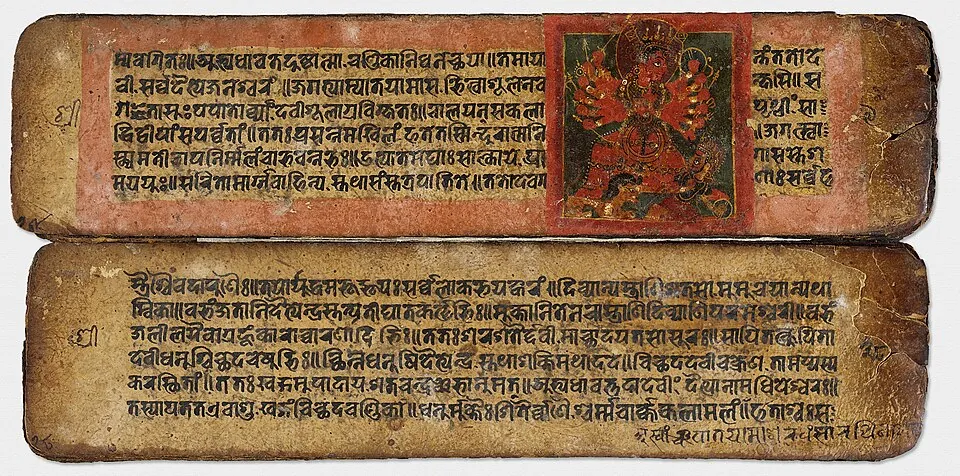
Devī Māhātmya Praises the Goddess as Supreme Reality
Devī Māhātmya · देवीमाहात्म्य
Shown in the Puranic cosmic layer; scholars date the text itself to about 550 CE.
The Devī Māhātmya, a 700-verse text forming part of the Mārkaṇḍeya Purāṇa, presents the Goddess as ultimate reality and recounts her victory over Mahiṣāsura. It is a foundational scripture of Śāktism, dated by scholars to about the sixth century CE.
The Devī Māhātmya, or Glory of the Goddess, is a Sanskrit text of 700 verses in thirteen chapters, embedded in chapters 81 to 93 of the Mārkaṇḍeya Purāṇa. It is also known as the Durgā Saptaśatī or Caṇḍī Pāṭh. Its central story shows the Goddess, appearing as Durgā, leading the divine forces against the buffalo demon Mahiṣāsura and prevailing in fierce combat. Behind the narrative lies a theological claim: that Brahman, the ultimate reality, is the Divine Mother, here named Ādi Parāśakti. Among surviving works it ranks as one of the earliest complete Hindu texts devoted to honouring the feminine aspect of the divine, and it stands beside the Devī Bhāgavata Purāṇa and the Devī Upaniṣad as a pillar of Śākta literature. Wikidata gives a publication date of around 550 CE, which scholars treat as an approximation for a work of uncertain composition. Today it is recited during Navarātri, at Durgā Pūjā, and in Durgā temples across the subcontinent, keeping the text a living part of worship.
Sources
- Devi Mahatmya Wikipedia · CC-BY-SA-4.0
- Q1206760 Wikidata · CC0-1.0