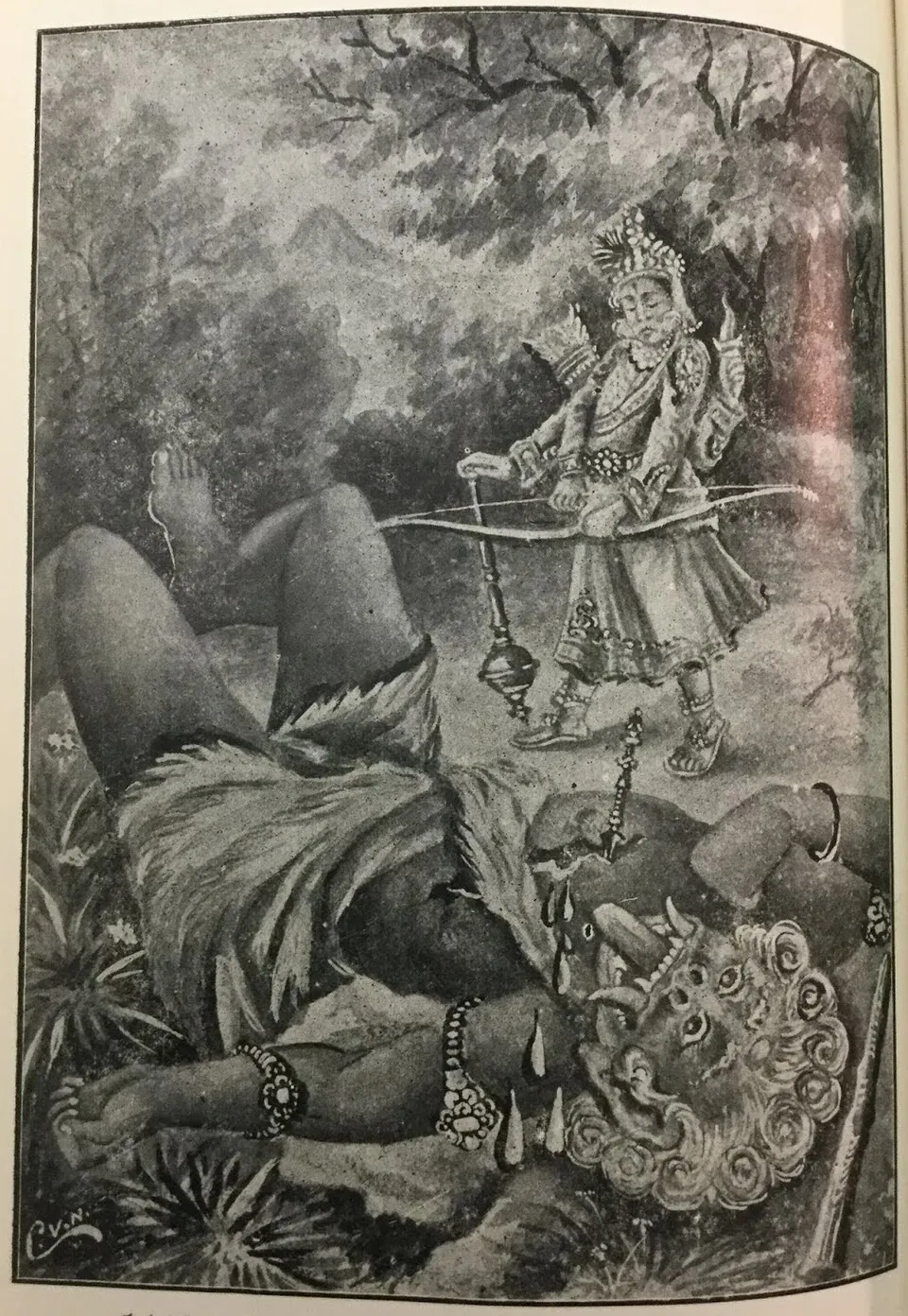
Indra Slays Vṛtra and Frees the Waters
Vṛtra · वृत्र
Traditional cosmic reckoning of the Purāṇas; not dated history.
In Vedic hymns the warrior god Indra kills the serpent-like Vṛtra, who has blocked the rivers, and releases the waters. Later Purāṇic tellings recast Vṛtra as a demon of drought. The myth is a sacred narrative placed in cosmic time, not a dated event.
The oldest account of the combat is found in the Ṛgveda, where Indra, fortified by soma and armed with a newly shaped thunderbolt, destroys Vṛtra, whose name means 'the enveloper'. Vṛtra, also called Ahi, the serpent, lies across the mountains and keeps the rivers from flowing; once he is split open, the waters rush down to the sea and the sun can be seen again. The Purāṇas later describe him as a dānava, a member of the asura clan, and as a personification of drought. Students of comparative mythology often set the tale beside other dragon-slaying stories of Indo-European peoples, though such comparisons remain debated. In ritual and poetry the victory stood for the ordering of the world against obstruction and the renewal of life through rain. The myth also explains why Indra became the chief of the gods in early Vedic religion. Because the narrative belongs to sacred tradition and not to evidence of a datable occurrence, it is anchored in the cosmic era with a symbolic date.