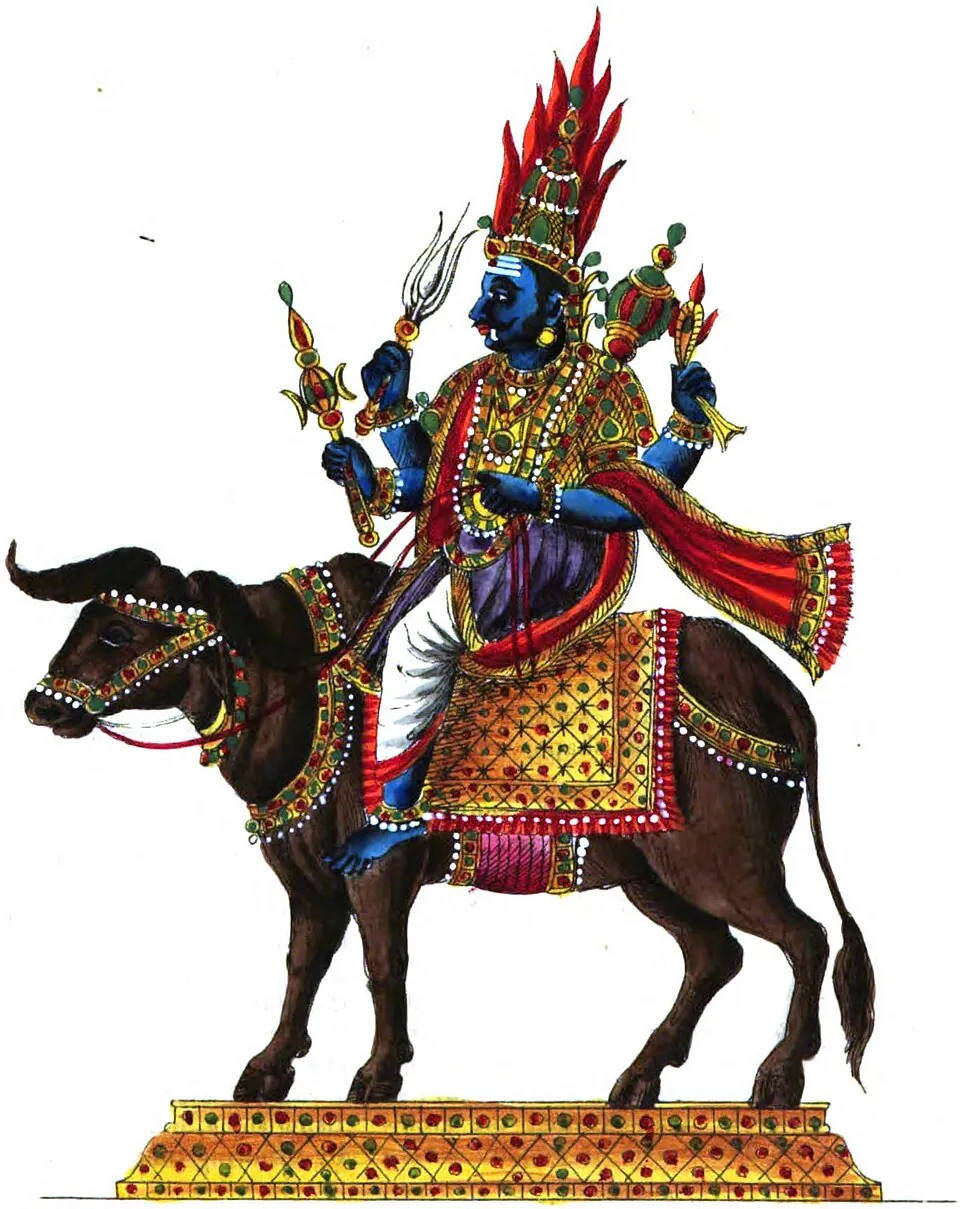
Yama, Lord of the Departed and of Dharma
Yama · यम
Placed at the start of the traditional cosmic timeline; sacred figure, not dated history.
In Vedic tradition Yama is the first mortal to have died and found the path to the heavens, and so becomes ruler of the dead. Later texts make him the god of death and justice, son of Sūrya, guardian of the southern quarter, and judge who assigns souls to ancestors, Naraka or rebirth.
Yama, whose name means twin, is remembered in Hindu tradition as the deity who presides over death and the judgement of deeds. The oldest Vedic stratum describes him as the first human to die, the one who discovered the road to the realm of the departed and therefore became its king. He is paired with his twin sister Yamī and is named as a child of Sūrya, or in earlier layers of Vivasvat, and Saṃjñā. His character and his abode are developed in the Upaniṣads, the epics and the Purāṇas alike. In the Purāṇic picture he weighs the conduct of each soul and sends it to the Pitṛs, the ancestors, to Naraka, or back to earthly birth. He is also one of the Lokapālas, the guardians of the directions, and watches over the south. Images show him as a dark figure riding a buffalo and holding a noose or a mace. He is also called Dharmarāja and Kāla, and is often linked with Dharma personified, although the two have separate origins. Later he was taken into Buddhist, Chinese, Tibetan, Korean and Japanese belief as lord of the underworld. As a sacred figure he belongs to traditional narrative, not to a datable historical record.