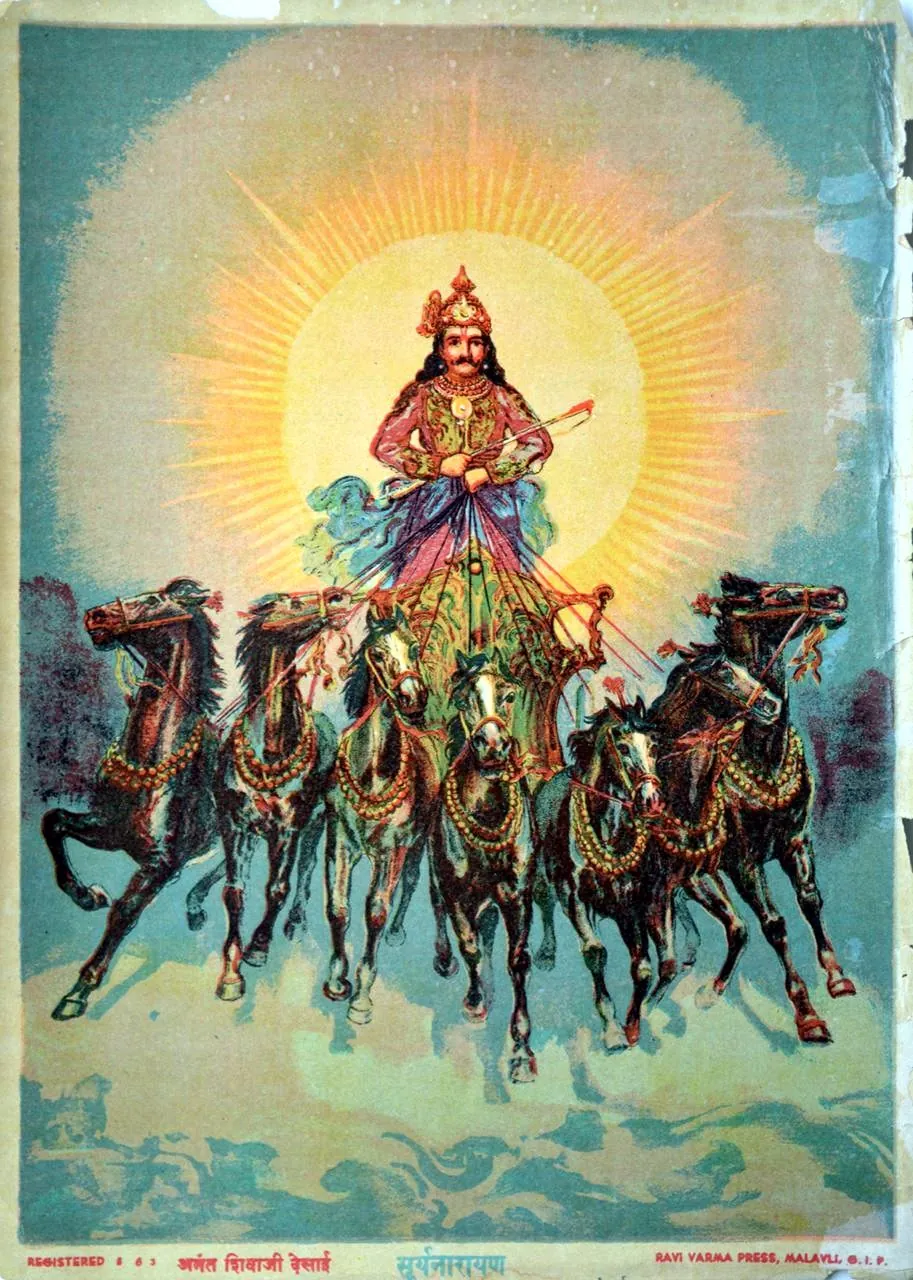
Sūrya, the Sun God and His Long Worship
Sūrya · सूर्य
Cosmic placement for a deity of Vedic and Purāṇic tradition; not a historical date.
Sūrya is the Sun as a deity in Hinduism, counted among the five principal gods of the Smārta tradition. Shown driving a chariot drawn by seven horses, he is linked with the Ādityas, the Sunday weekday and festivals such as Makar Saṅkrānti. His temple worship waned from about the thirteenth century.
Sūrya, the solar deity, appears throughout Indian literature under many names, among them Ravi, Vivasvān and Bhāskara. The Smārta tradition ranks him among five deities whose joint worship in the pañcāyatana pūjā is a route to realising Brahman. He is often drawn in a chariot pulled by seven horses, read as the colours of light or the days of the week, and he is tied to the Ādityas, a group of solar aspects that includes Savitṛ and Pūṣan. Epic tradition makes him father of Sugrīva and of Karṇa. In medieval practice worshippers addressed Brahmā at dawn, Viṣṇu at noon and Śiva at dusk, while Sūrya was also merged with other gods in syncretic images. He is honoured at Makar Saṅkrānti, Pongal, Ratha Saptamī and Chaṭh, and at the Kumbha Melā. His cult was strongest in Rajasthan, Gujarat, Bihar and neighbouring regions. After about the thirteenth century, new sun temples were rarely built, and he was increasingly absorbed into the worship of Viṣṇu or Śiva. This entry uses the traditional cosmic placement for divine origins.