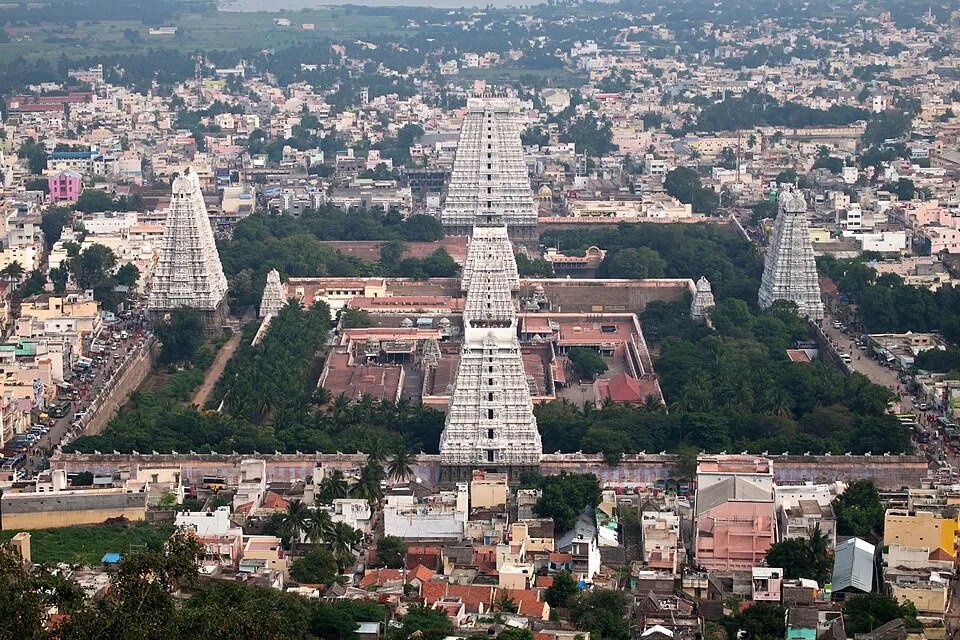
Annamalaiyar Temple Rises Beneath the Fire Hill
Aruṇācaleśvara · अरुणाचलेश्वर
The Annamalaiyar Temple at Tiruvannamalai, in Tamil Nadu, honours Śiva as the Fire Liṅga at the foot of Mount Aruṇācala. Its present stone fabric dates from the Chola period around the ninth century, with major additions under Vijayanagara patronage, and it remains among the largest temple complexes in India.
At the foot of the sacred hill Aruṇācala in Tiruvannamalai stands the Annamalaiyar Temple, where Śiva is worshipped as the Agni Liṅga, the form associated with fire among the five elements honoured at the Pañcabhūta Sthalams. His consort is revered here as Uṇṇāmulai Ammai. In Tamil tradition the deity's name is understood to mean the mountain that cannot be approached, and the hill itself is treated as the god's living embodiment. The shrine is celebrated in the Tēvāram hymns of the Nāyaṉmār, in Māṇikkavācakar's Tiruvempāvai and in the fourteenth-century Tiruppukaḻ of Aruṇagirināthar, which together show how long devotion has gathered here. The standing masonry temple is generally attributed to the Chola age, around the ninth century, and later rulers, notably those of Vijayanagara, enlarged it considerably. Roughly ten hectares in area, the complex ranks among the biggest in the country. Four towering gateways mark its approaches; the eastern one rises eleven storeys to about sixty-six metres. The date given here is an approximation for the Chola building phase, since construction continued across centuries.
Sources
- Arunachalesvara Temple Wikipedia · CC-BY-SA-4.0
- Q3523924 Wikidata · CC0-1.0