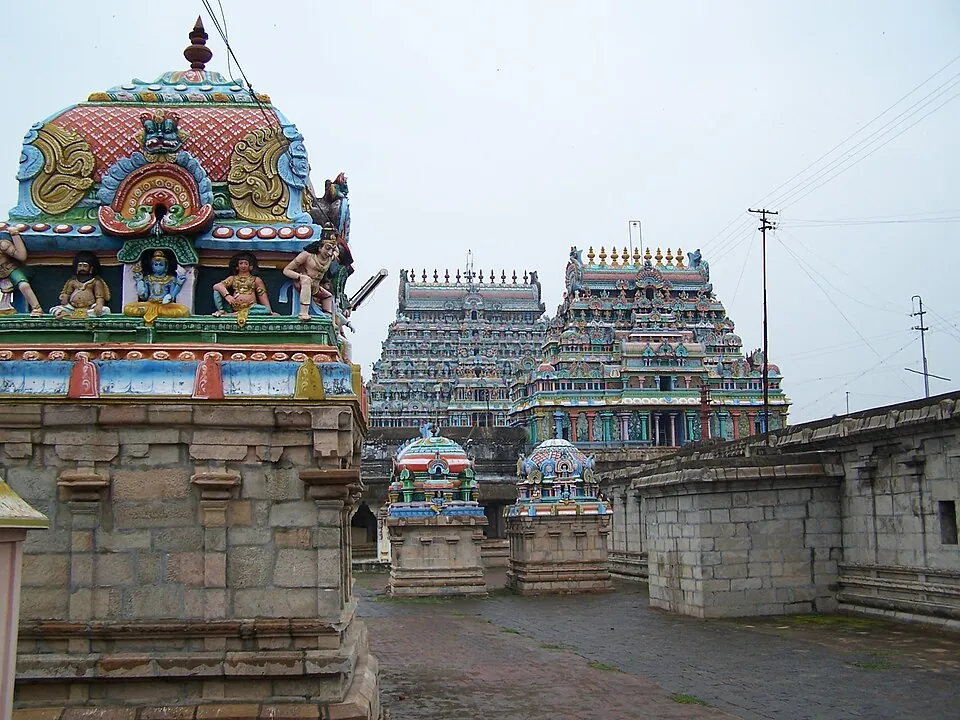
Tyāgarāja Temple at Tiruvārūr
Tiruvārūr · तिरुवारूर
The Tyāgarāja temple at Tiruvārūr in Tamil Nadu is a vast Śiva complex, praised in the seventh-century Tēvāram hymns. Its stonework in the present form dates to Chola times, and it has nine gopuras, a prominent Kamalāmbā shrine and a long tradition of festivals.
At Tiruvārūr in Tamil Nadu stands the Tyāgarāja temple, where Śiva is worshipped in the form of a liṅga as Tyāgarājasvāmi, also called Putridankondār. His consort, the goddess Pārvatī, is honoured as Nīlotpalāmbikā and as Kamalāmbā, in a separate shrine that is important for Śākta and Tantric tradition and counted among the Śakti Pīṭhas. The god of the place is praised in the Tēvāram, the Śaiva hymns of the seventh century, which makes the shrine a Pāṭal Peṟṟa Sthalam, a site sung by the Nāyanār saints. The masonry temple that stands today was raised under the Cholas, with building work from about the ninth century, and later rulers added to it. It covers around eight hectares, with nine towered gateways, the tallest of them the four-storey eastern gopura about thirty metres high. The date used here is an approximation for its Chola-era build-up. The town is also remembered as the birthplace of the composers Tyāgarāja, Muttusvāmi Dīkṣita and Śyāmā Śāstri.
Sources
- Thyagaraja Temple, Tiruvarur Wikipedia · CC-BY-SA-4.0
- Q7799552 Wikidata · CC0-1.0