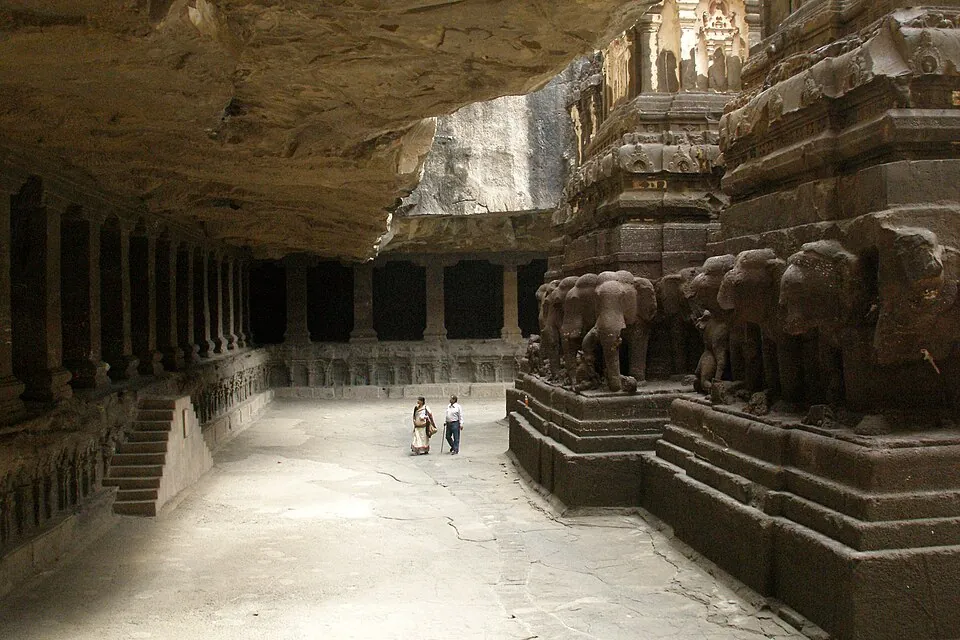
Ellora Carves Faiths into the Basalt Cliffs
Ellora · एलोरा
The Ellora complex near Aurangabad holds more than a hundred rock-cut caves, of which thirty-four are open to visitors, cut into basalt cliffs between about 600 and 1000. Buddhist, Hindu and Jain monasteries and shrines stand side by side, crowned by the monolithic Kailāsa temple of Śiva.
Ellora, a UNESCO World Heritage Site near Aurangabad in Maharashtra, is among the largest rock-cut complexes anywhere. Over a hundred excavations pierce the basalt escarpment of the Charanandri hills, and thirty-four are open to the public: twelve Buddhist caves, seventeen Hindu and five Jain, arranged in sequence along the cliff. Work began around the seventh century and continued to roughly the year 1000. Much of the Hindu and Buddhist excavation took place under the Rāṣṭrakūṭa dynasty, who ruled from 753 to 982, while the Jain caves were added later during Yādava times. Kings, merchants and wealthy patrons paid for the labour. Cave 16, the Kailāsa temple, dedicated to Śiva, is the crowning achievement: a chariot-shaped sanctuary hewn downward from the rock as one monolith, with sculpted deities and panels that condense the two great epics into stone. Several of the caves lack roofs and are not caves in the strict sense. Because monasteries and shrines of three traditions were cut close together, Ellora is often cited as evidence of coexistence in the early medieval Deccan.
Sources
- Ellora Caves Wikipedia · CC-BY-SA-4.0
- Q189616 Wikidata · CC0-1.0