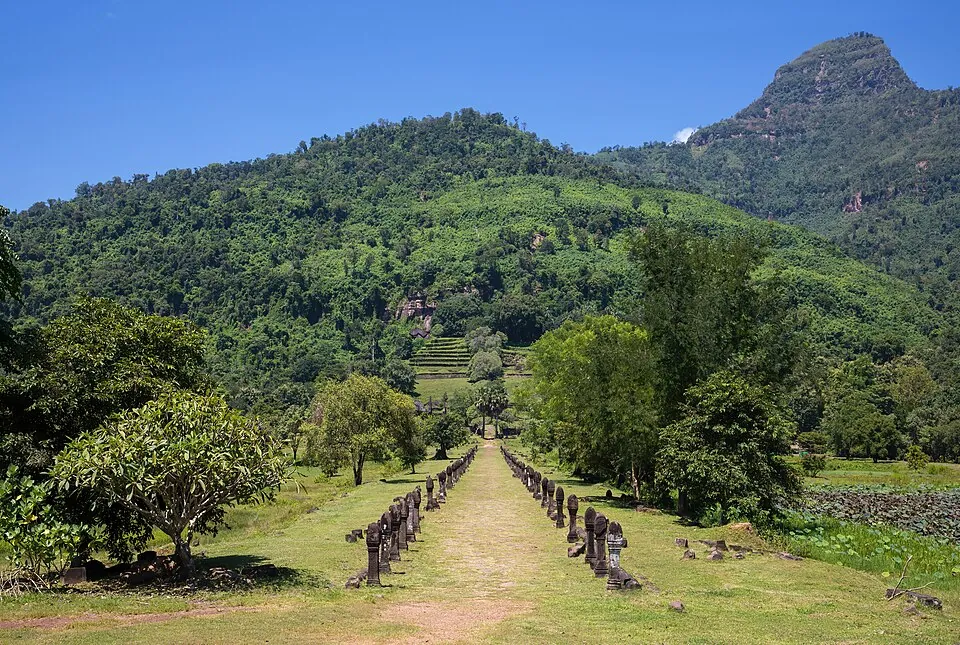
Vat Phou, a Mountain Sanctuary in Southern Laos
Vat Phou, a ruined Khmer-era Hindu temple complex in southern Laos, grew up around an older sanctuary at a spring. Its earliest stone structures may go back to the second century BCE, and a pre-Angkorian brick building raised in the seventh century became the focus of later construction.
Vat Phou lies in the south of Laos at the foot of a mountain and is a UNESCO World Heritage Site. Long before the Khmer temples appeared, a sanctuary there centred on a natural spring and an offering place for a guardian spirit, a tradition reaching back to prehistoric times. The first megalithic stone structures were probably built as early as the second century BCE and consisted of two stone cells, a carved crocodile, serpent-shaped stairs and platforms for offerings. One of the brick buildings of the pre-Angkor period was erected in the seventh century CE, and this became the focus for the later construction that gave the site its present form, as Khmer builders added terraces, causeways and shrines across the following centuries. The plan places the main sanctuary at the end of a long axis, with water from the sacred spring channelled to the temple, reflecting a Hindu conception of a holy mountain dedicated chiefly to Śiva. The date shown is that of the seventh-century brick building, since the older stone and earth features are less securely dated.