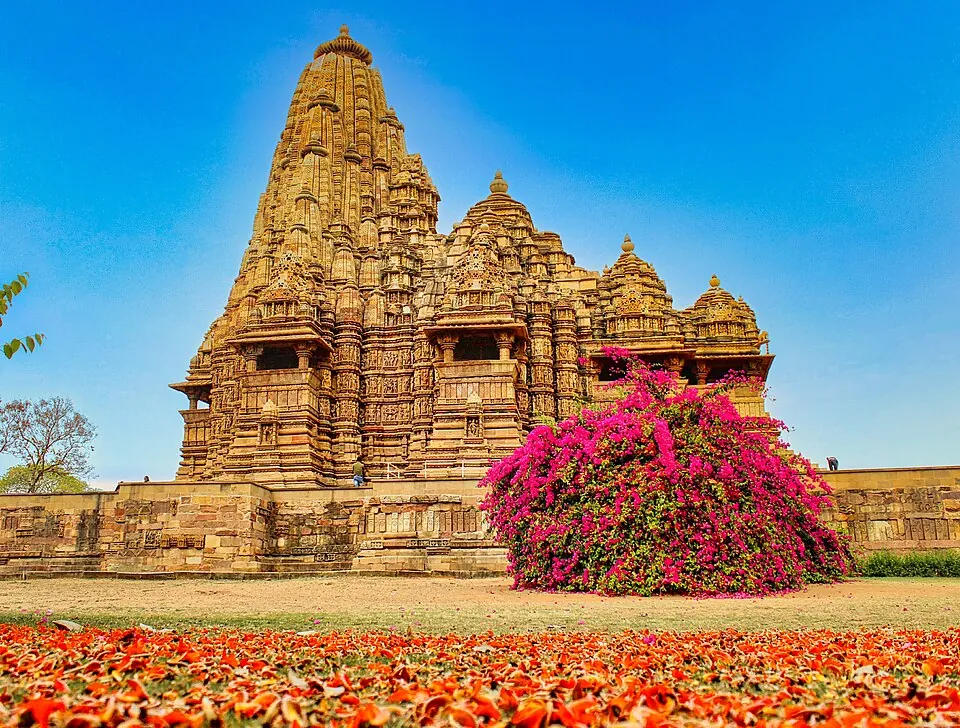
Chandela Builders Raise the Kandariya Mahādeva
The Kandariya Mahādeva at Khajuraho, raised in the Chandela period around 1030, is the largest and most elaborately carved temple of its group. Its towering spire and dense sculpture made it a landmark of north Indian temple art, and UNESCO inscribed the site in 1986.
The Kandariya Mahādeva, whose name can be rendered as the great god of the cavern, is the grandest of the medieval temples at Khajuraho in Madhya Pradesh. It is usually assigned to the reign of the Chandela king Vidyādhara in the early eleventh century, a time when the dynasty was at the height of its patronage of architecture. Dedicated to Śiva, the temple rises from a high platform through a sequence of porches to a clustered spire of many miniature peaks, evoking a mountain. Its walls carry thousands of sculpted figures arranged in bands, among them deities, celestial maidens, musicians, couples and guardians, all carved with remarkable finesse in sandstone. Few Indian temples of the period have survived in such good condition, which is one reason it is treated as a model for the northern Nāgara style. Khajuraho's temple group entered the UNESCO World Heritage list in 1986 as an outstanding witness to Chandela culture. The year 1030 is a convenient anchor for a building campaign that spanned some years.
Sources
- Kandariya Mahadeva Temple Wikipedia · CC-BY-SA-4.0
- Q648390 Wikidata · CC0-1.0