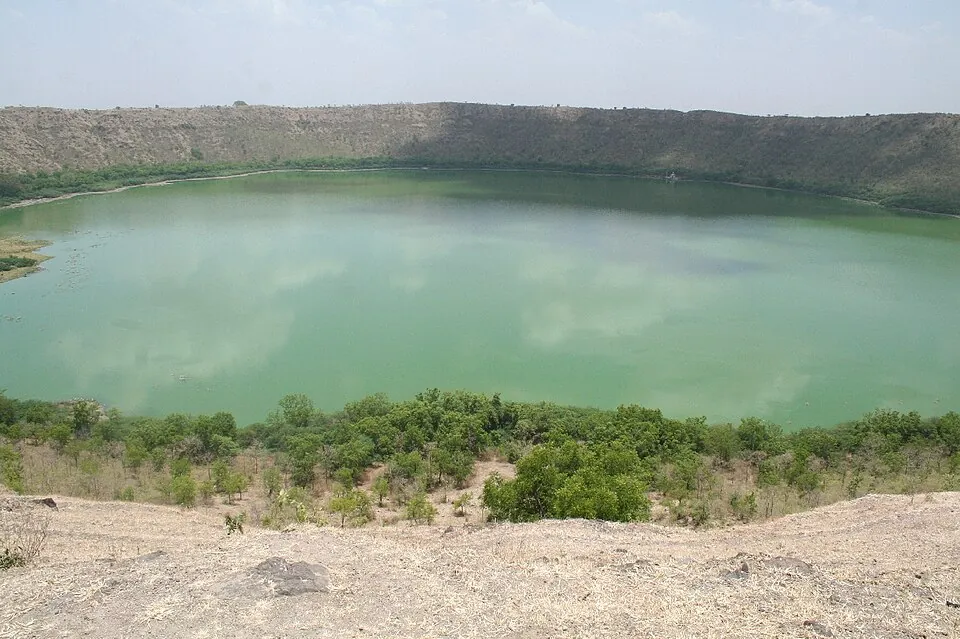
Lonar Lake and Its Ring of Temples
Lonar in Maharashtra holds a saline lake inside a meteorite impact crater formed in basalt, found nowhere else in India. Medieval builders raised stone temples around the crater, among them the Daitya Sūdana shrine, so the site blends deep geological history with long-standing sacred use.
Lonar Lake sits in Buldhana district of Maharashtra, inside a bowl about 1.8 kilometres across and 150 metres deep. It formed when a meteorite struck the volcanic basalt of the Deccan Plateau, and no other crater of this origin is known in India. Its age is debated, with published estimates ranging from tens of thousands to several hundred thousand years. Around the rim and shore, medieval communities built stone temples in the style often called Hemāḍpanti, which uses dry-laid blocks without mortar. The best known is the Daitya Sūdana temple, whose name recalls a local legend of a demon destroyed by Viṣṇu. Exact construction dates for these shrines are uncertain and most are assigned broadly to the early centuries of the second millennium, so the date used here is only an approximation for the period of temple building. Today the site enjoys protection as a geological monument and a wetland of international importance, and it draws both earth scientists and pilgrims who see one landscape through very different kinds of curiosity.
Sources
- Lonar Lake Wikipedia · CC-BY-SA-4.0
- Q2572189 Wikidata · CC0-1.0