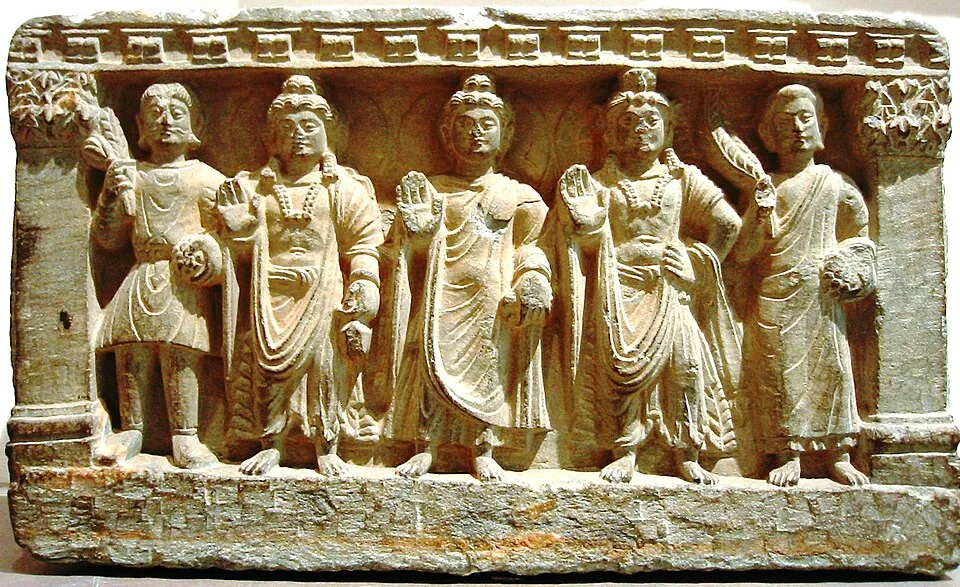
The Rise of Mahāyāna Buddhism
Mahāyāna · महायान
Mahāyāna, the Great Vehicle, emerged in ancient India from about the first century BCE and became the largest branch of Buddhism. It stresses the bodhisattva ideal and accepts scriptures such as the Lotus Sūtra that Theravāda does not regard as canonical.
Mahāyāna, meaning Great Vehicle, is the larger of the two surviving branches of Buddhism, the other being Theravāda. It took shape within Indian Buddhist communities from roughly the first century BCE onward and developed in a wide variety of regions afterwards. Followers keep the core teachings of early Buddhism but also honour additional scriptures, among them the Lotus Sūtra and the Diamond, or Vajracchedikā, Sūtra, which Theravāda does not accept as canonical. These works put the bodhisattva ideal at the centre of practice. A bodhisattva is a being who vows to reach complete awakening as a buddha so as to help all living creatures, motivated by a compassion called bodhicitta. The scriptures also set out distinctive doctrines, including the perfection of wisdom and the idea of buddha-nature. The path itself is sometimes named the Bodhisattvayāna. The date given here is an approximate marker, since the movement emerged gradually and the sources do not allow a precise founding year. From India the tradition travelled to Central Asia, China, Korea, Japan and Tibet and shaped the Buddhist cultures of those lands.