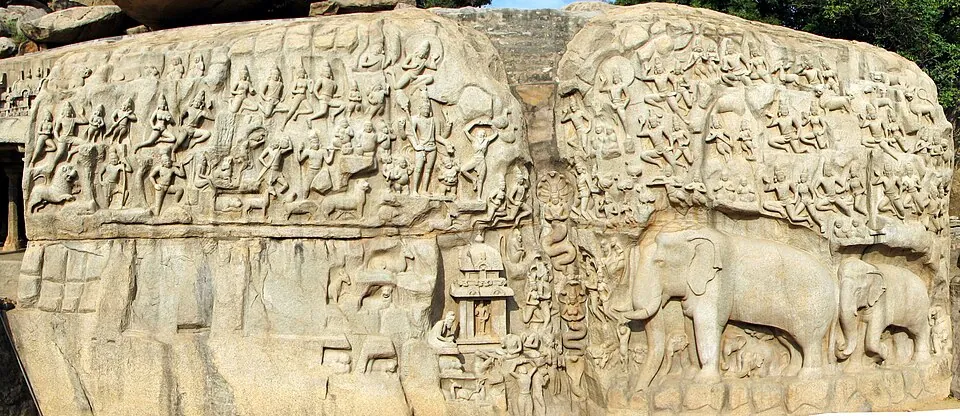
Arjuna's Penance Carved at Mamallapuram
Mahābalipuram · மகாபலிபுரம்
At Mamallapuram on the Coromandel Coast, Pallava artists carved a vast open-air relief, about 29 by 13 metres, on two great boulders. Known as Arjuna's Penance or the Descent of the Ganges, it shows gods, humans and animals around a cleft that represents the sacred river.
At Mamallapuram, in Chengalpattu district of Tamil Nadu on the Bay of Bengal, an enormous relief covers two adjoining boulders and measures roughly 29 metres by 13 metres. It is dated to the seventh century and is attributed to Pallava patronage, in the age of Narasiṃhavarman I, called Mamalla. The scene carries two names, Arjuna's Penance and the Descent of the Ganges, because scholars read it as depicting either the descent of the heavenly river to earth in the story of Bhagīratha, or the austerities of the Pāṇḍava hero Arjuna, or both at once. A natural cleft down the middle of the rock is treated as the river, with nāgas rising from it, and around it crowd gods, celestial beings, hunters, ascetics and a procession of lifelike animals, among them a famous group of elephants. Rather than a simple narrative panel, it works like a canvas for a whole world, with the sacred stream at its centre. The relief belongs to the Pallava heritage site, a group of monuments that also includes the Shore Temple, and it remains one of the great achievements of early South Indian sculpture.
Sources
- Descent of the Ganges (Mahabalipuram) Wikipedia · CC-BY-SA-4.0
- Q1753664 Wikidata · CC0-1.0