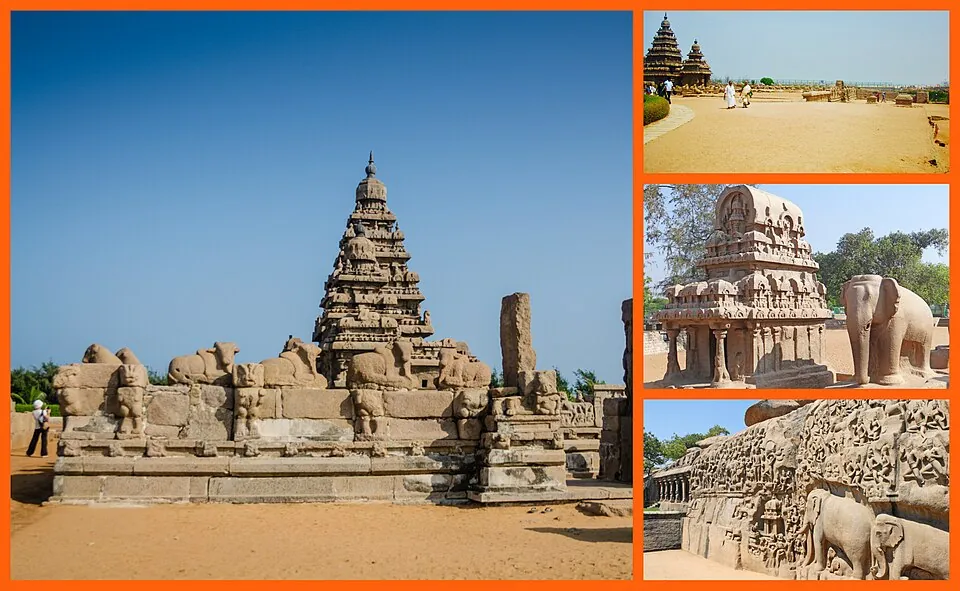
Group of Monuments at Māmallapuram Takes Shape
Māmallapuram · மாமல்லபுரம்
The monuments at Māmallapuram, also called Mahābalipuram, were built under the Pallavas in the seventh and eighth centuries. They include monolithic ratha temples, cave temples, huge rock reliefs such as the Descent of the Gaṅgā, and later structural temples, and are a UNESCO World Heritage Site.
Māmallapuram, or Mahābalipuram, on the Coromandel Coast of Tamil Nadu about sixty kilometres south of Chennai, holds about forty ancient monuments and Hindu temples built under the Pallava dynasty in the seventh and eighth centuries CE. The group is a UNESCO World Heritage Site. It comprises several kinds of monument. The ratha temples, carved from single pieces of rock to resemble processional chariots, were made between about 630 and 668. There are also mandapa cave temples whose walls show episodes from the Mahābhārata, with inscriptions in several scripts and languages, and rock reliefs, among which the Descent of the Gaṅgā, also known as Arjuna's Penance, is one of the largest open-air carvings in the world. Free-standing stone temples, including the Shore Temple, were constructed between about 695 and 722, and excavations have uncovered traces from the sixth century and earlier. Taken together the complex records the experiments by which South Indian builders moved from rock-cut forms to freestanding stone architecture, shaping the Dravidian tradition. The dates given are a range for the main phases of construction rather than a single founding year.
Sources
- Group of Monuments at Mahabalipuram Wikipedia · CC-BY-SA-4.0
- Q3522747 Wikidata · CC0-1.0