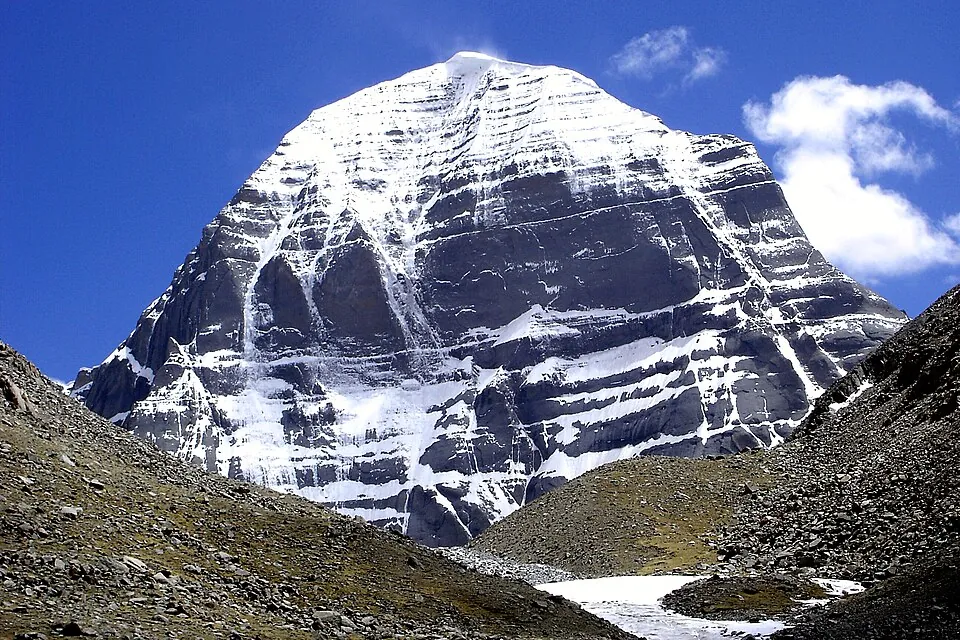
Mount Kailash, Sacred Peak of Four Faiths
Kailāśa · कैलाश
Purāṇic sacred geography set in cosmic time; not dated history.
Mount Kailash, rising to about 6,638 metres in western Tibet, is revered in Hinduism as the abode of Śiva and is sacred also to Buddhists, Jains and followers of Bon. Four great rivers rise nearby. Pilgrims circle the mountain on foot. Its place in Purāṇic tradition is sacred narrative, not dated history.
Kailash stands in the Gangdise range of the Transhimalaya, in the Ngari region of the Tibetan Plateau, close to the lakes Manasarovar and Rakṣastal. The headwaters of the Indus, Sutlej, Brahmaputra and Ghaghara all lie in its vicinity, a fact that has long fed its sacred reputation. In Hindu tradition it is the home of Śiva and Pārvatī, a mountain at the centre of the world in Purāṇic imagination. Buddhists, Jains and followers of the Bon religion each hold it holy in their own terms. Pilgrimage groups travel to Lake Manasarovar and then walk a circuit around the peak, an act of devotion that takes several days at high altitude. Although the summit has been surveyed by climbers, no successful ascent is recorded, and the Chinese authorities forbid climbing out of respect for its religious significance. The date used on this timeline is a conventional marker for Purāṇic cosmic time, signalling mythic status rather than a dated event.
Sources
- Mount Kailash Wikipedia · CC-BY-SA-4.0
- Q229107 Wikidata · CC0-1.0