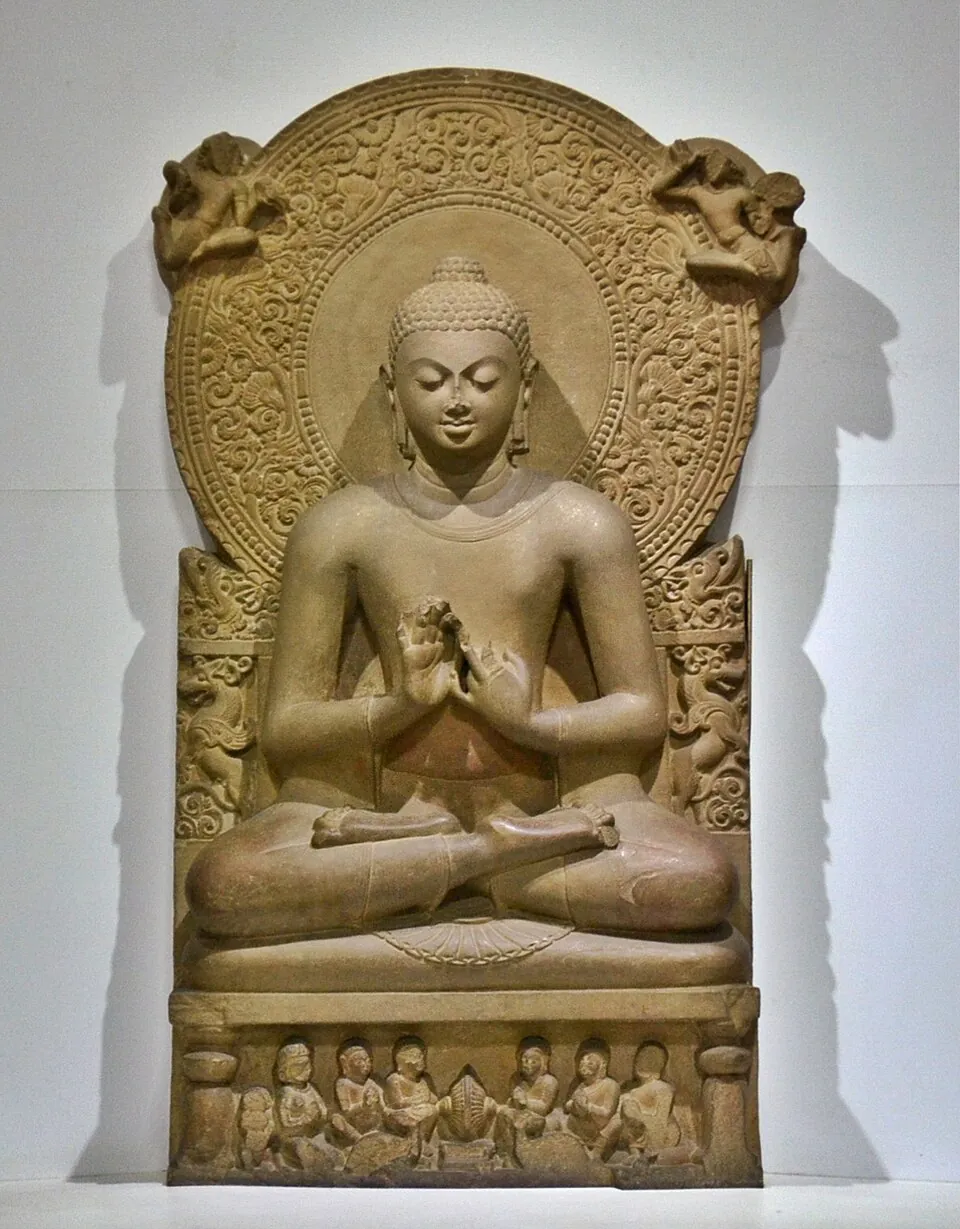
The Buddha Preaching, Sarnath Sculpture
A fifth-century stone relief from Sarnath shows the Buddha in the teaching posture, turning the wheel of dharma. Excavated in 1904 to 1905, it is regarded as a hallmark of the Sarnath school and one of the best-known Gupta-period images of the Buddha.
This stone sculpture, carved in the fifth century CE, depicts Gautama Buddha making the dharmacakra-pravartana mudrā, the hand gesture associated with his first sermon. The relief stands about 160 centimetres tall. F. O. Oertel found it during the 1904 to 1905 season of the Archaeological Survey of India's excavations at Sarnath, in an area south of the Dhamek Stūpa. It belongs to the local Sarnath school of sculpture, and the way it renders the subject is considered a signature of that school's Buddhist art. Since the site museum opened in 1910, the first of its kind created by the Survey, the piece has been shown there. Art historians have given it high praise: Denise Leidy has called it justifiably among the most famous portrayals of the Buddha in Asian art, and Robert Fisher has described it as the best-known Gupta Buddha image. Its serene face, smooth drapery and haloed head illustrate the refined style of Gupta workshops, and it links to the very spot where, by tradition, the Buddha first taught.
Sources
- Buddha Preaching his First Sermon (Sarnath) Wikipedia · CC-BY-SA-4.0
- Q104830278 Wikidata · CC0-1.0