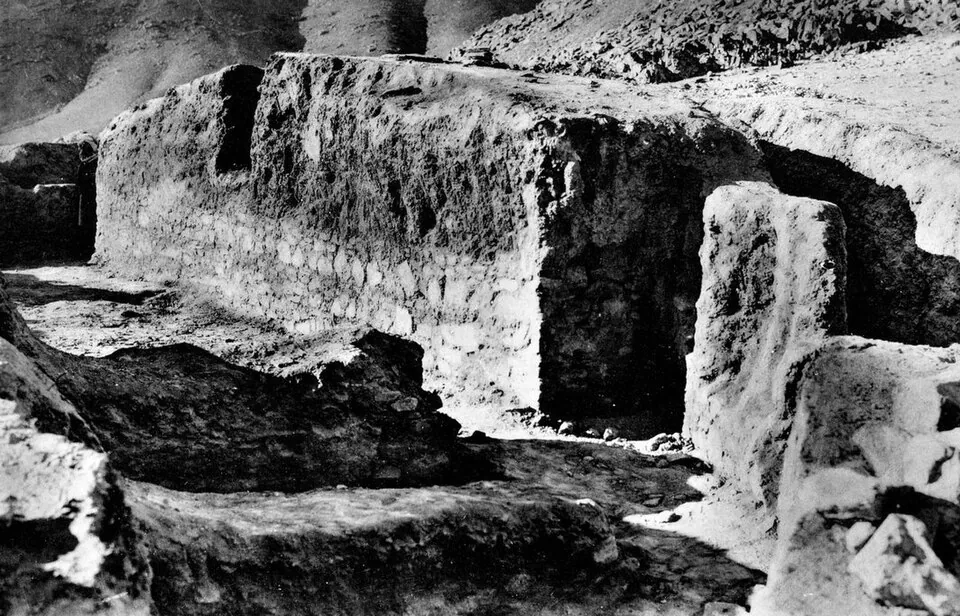
Khair Khāneh, a Sun-God Sanctuary near Kabul
Khair Khāneh is an archaeological site near Kabul, Afghanistan, excavated in the 1930s by Joseph Hackin. A marble statue found there is regarded by some scholars as a solar deity close to the Iranian Mithra, and coin evidence has been cited in support of the identification.
Khair Khāneh is an archaeological site not far from Kabul in Afghanistan, excavated in the 1930s by the French archaeologist Joseph Hackin. The finds belong to the late phase of the Kabul region's history, when rulers of Indo-Iranian and Turkic descent governed the valley and patronised Buddhist and Hindu traditions alike. The most celebrated discovery is a marble statue of a solar deity. Some scholars consider it to represent Mithra, arguing that this sun god is as near as possible to the Iranian Mithra, and they point to numismatic evidence as removing doubt about the connection with Mithras. Others see the figure as an Indian sun god, Sūrya, rendered in a local style and with a distinct dress, which would show how religious ideas and iconographic conventions travelled across the Hindu Kush. The question has not been fully resolved. The statue is therefore valuable evidence of the cultural meeting of South Asia, Central Asia and Iran in the sixth and seventh centuries. The date given is an approximation for the sculpture and the temple phase and is not tied to any precisely dated record.
Sources
- Khair Khaneh Wikipedia · CC-BY-SA-4.0
- Q101187949 Wikidata · CC0-1.0