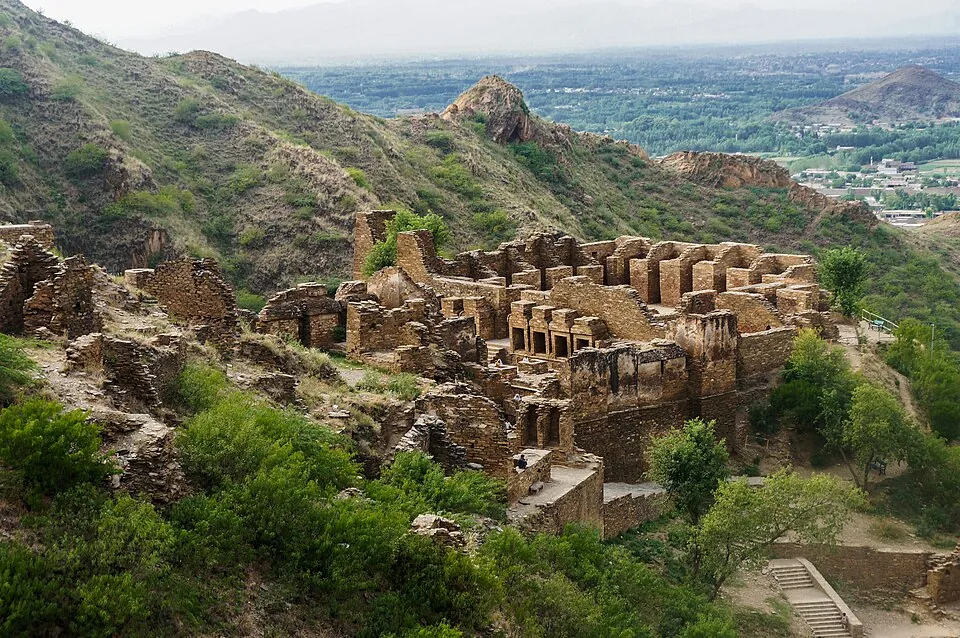
Takht-i-Bahi Buddhist Monastery in Gandhāra
Takht-i-Bāhī · تختِ باہی
Takht-i-Bahi, near Mardan in Khyber Pakhtunkhwa, is the ruin of a Buddhist monastery founded in the first century CE and used until the seventh. Regarded as one of the most important Buddhist remains of Gandhāra, it was listed as a UNESCO World Heritage Site in 1980.
Takht-i-Bahi, a name meaning throne of the water spring in Pashto and Urdu, is a site of the Indo-Parthian period in the Mardan district of Khyber Pakhtunkhwa, in present-day Pakistan. It preserves the remains of a Buddhist monastery that is counted among the most significant relics of the Buddhist world of ancient Gandhāra. The monastery was founded in the first century CE and remained in use until the seventh century, so its life spans the Kushan and later periods when the region was a crossing point of Indian, Iranian and Central Asian cultures. Archaeologists consider the complex particularly representative of how Buddhist monastic centres of that era were laid out, with courtyards, stupas, assembly rooms and cells arranged on a hilltop. The state of preservation is a further reason for its fame. When UNESCO inscribed it as a World Heritage Site in 1980, it described the monument as exceptionally well preserved. The date given here, 100, is approximate and refers to the traditional century of foundation. Today the site is a reminder that the Buddhist heritage of the north-west belongs to the shared history of the subcontinent and is read together with sites in India.
Sources
- Takht-i-Bahi Wikipedia · CC-BY-SA-4.0
- Q117623 Wikidata · CC0-1.0