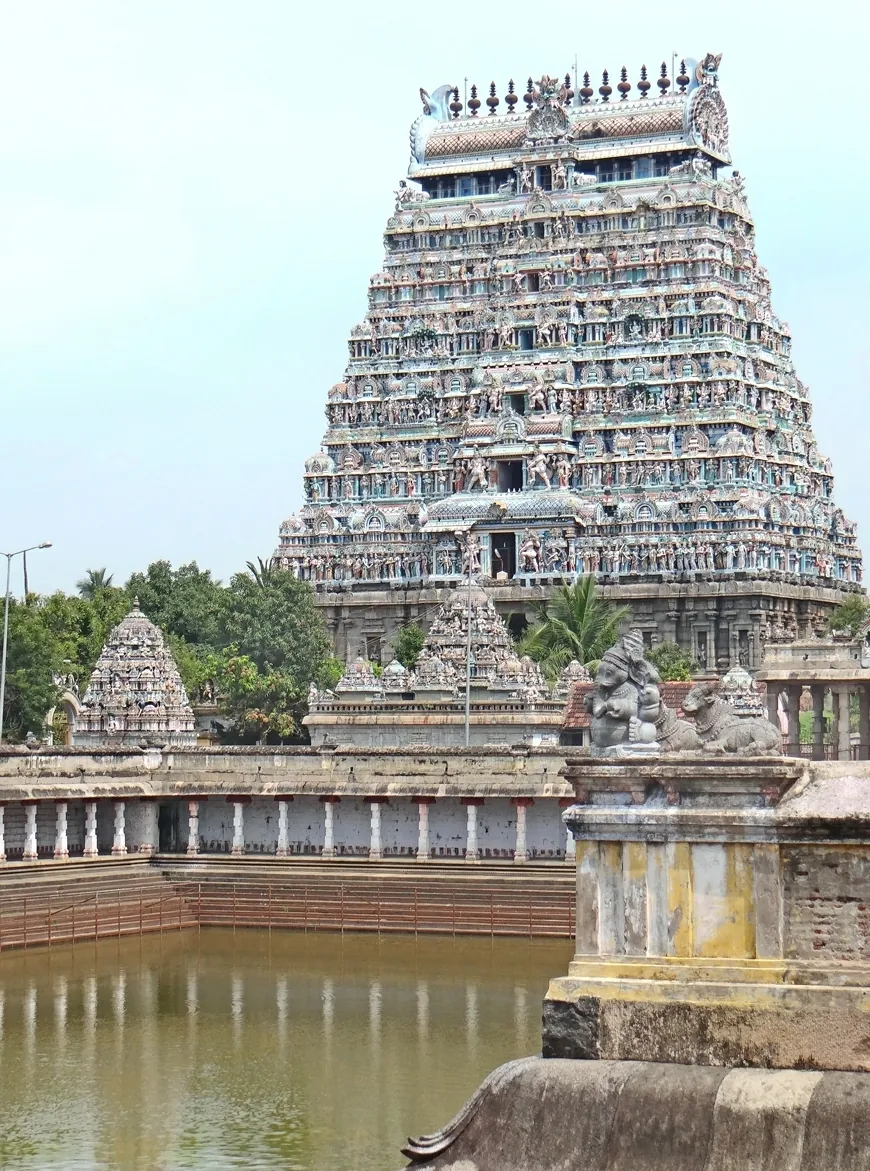
Chidambaram's Nataraja Temple in Chola Times
Naṭarāja Mandira, Cidambaram · நடராஜர் கோயில், சிதம்பரம்
The Nataraja temple at Chidambaram, dedicated to Śiva as lord of the dance, took much of its present form under the Cholas around the tenth century. Its carved walls show the dance poses of the Nāṭyaśāstra, linking sacred architecture with the performing arts, and it holds a special place in Tamil Śaiva tradition.
Chidambaram, once known as Thillai, was already home to a Śiva shrine before the Cholas made the town one of their principal centres. The temple is dedicated to Naṭarāja, Śiva as the cosmic dancer, and Tamil Śaivas simply call it Kōvil, the Temple. Its present layout was shaped by renovation in the tenth century, when Chola patronage turned the site into a major religious and artistic centre, and copper-plate grants from the dynasty refer to its gilded roof. The name Chidambaram is usually explained as meaning a stage of consciousness, a phrase that suits a shrine in which worship is imagined as a performance. Carvings on the walls illustrate the 108 karaṇas, the dance postures catalogued in the Nāṭyaśāstra attributed to Bharata, and these poses underpin the later vocabulary of Bharatanāṭyam. The temple is also counted among both the Pañca Sabhā and the Pañcabhūta groups of Śiva sites, a distinction few other shrines share. Its date here is approximate, because the building grew over several generations rather than in a single founding act, and the tenth century marks the phase that gave it its recognisable character.
Sources
- Nataraja Temple, Chidambaram Wikipedia · CC-BY-SA-4.0
- Q1966341 Wikidata · CC0-1.0