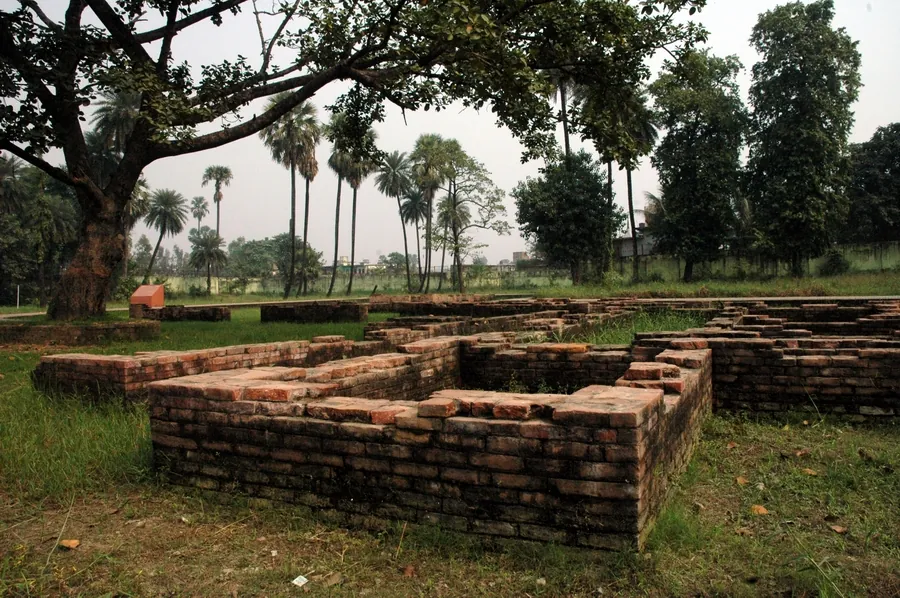
The Pillared Hall at Pāṭaliputra, Kumhrar
At Kumhrar in Patna, the Archaeological Survey of India has excavated from 1913 the remains of ancient Pāṭaliputra, including a hall once supported by eighty pillars. Finds belong to the Mauryan period, and the site's occupation runs from about 600 BCE to 600 CE, marking the capital of Ajātaśatru, Candragupta and Aśoka.
Kumhrar, about five kilometres east of Patna railway station, is the area where excavations from 1913 began to reveal the remains of Pāṭaliputra, the ancient capital on the Ganges. Among the finds are the ruins of a hypostyle hall with eighty pillars, assigned to the Mauryan period of about 322 to 185 BCE. The hall's polished stone columns recall the monumental style of Aśokan architecture and give a sense of the scale of the imperial court that Greek visitors such as Megasthenes described. The excavated material together spans four continuous periods from about 600 BCE to 600 CE, so the site documents the city from the age of Ajātaśatru through the reigns of Candragupta and Aśoka and on into the Gupta era. Pāṭaliputra was one of the largest cities of the ancient world, and Kumhrar remains the best preserved window into its royal quarter, though much of the capital lies beneath modern Patna. The date used here marks the Mauryan floruit at around 300 BCE.