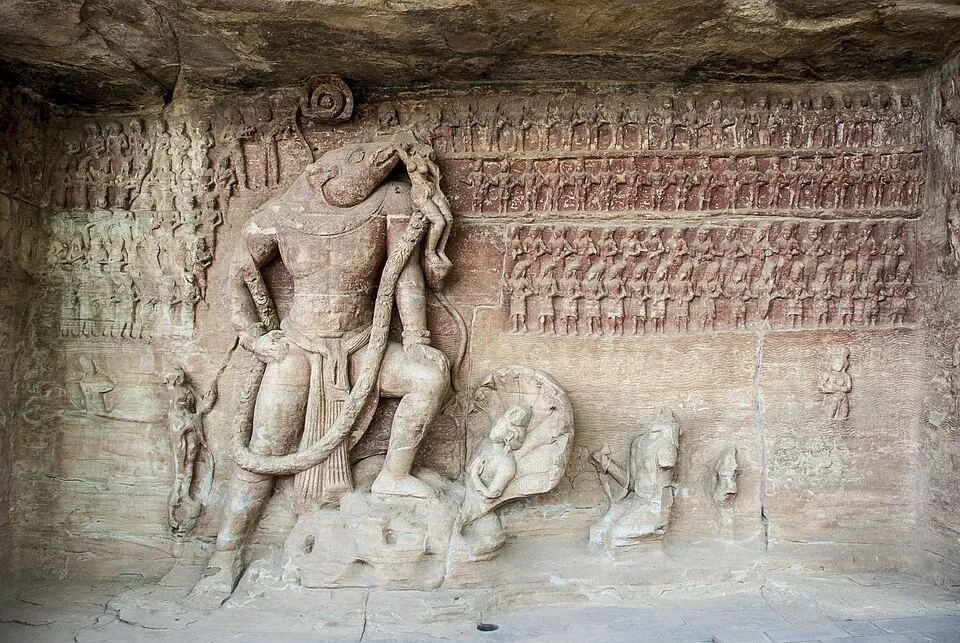
Udayagiri Caves and the Great Boar Relief
Udayagiri · उदयगिरि
The Udayagiri caves near Vidiśā, in Madhya Pradesh, are rock-cut shrines carved in the early fifth century under the Guptas. Inscriptions connect them with Candragupta II, and the colossal relief of Viṣṇu's boar incarnation, rescuing the earth, is one of the great monuments of Gupta sculpture.
Near the town of Vidiśā in central India, the sandstone hill of Udayagiri holds a set of rock-cut sanctuaries made in the early fifth century CE, during the Gupta period. Inscriptions at the site refer to Candragupta II, and a record dated 401 CE has been linked with his visit. Most of the twenty caves are small shrines cut into the hill, some dedicated to Viṣṇu, Śiva and the goddess, and a few belong to the Jain tradition. The best-known work is the monumental relief of Varāha, the boar form of Viṣṇu, who lifts the earth, personified as the goddess Bhū, from the cosmic waters. Surrounding figures of gods and sages crowd the scene, and a river goddess and sea figures appear below. Historians value it as an early, confident treatment of a sacred theme that is also read as a statement of royal power, since the king was likened to the saving god. The site also lies near the ancient city of Vidiśā and the Sāñcī stūpas, which makes the region a rich area for study of early India's religious art.
Sources
- Udayagiri Caves Wikipedia · CC-BY-SA-4.0
- Q4250472 Wikidata · CC0-1.0