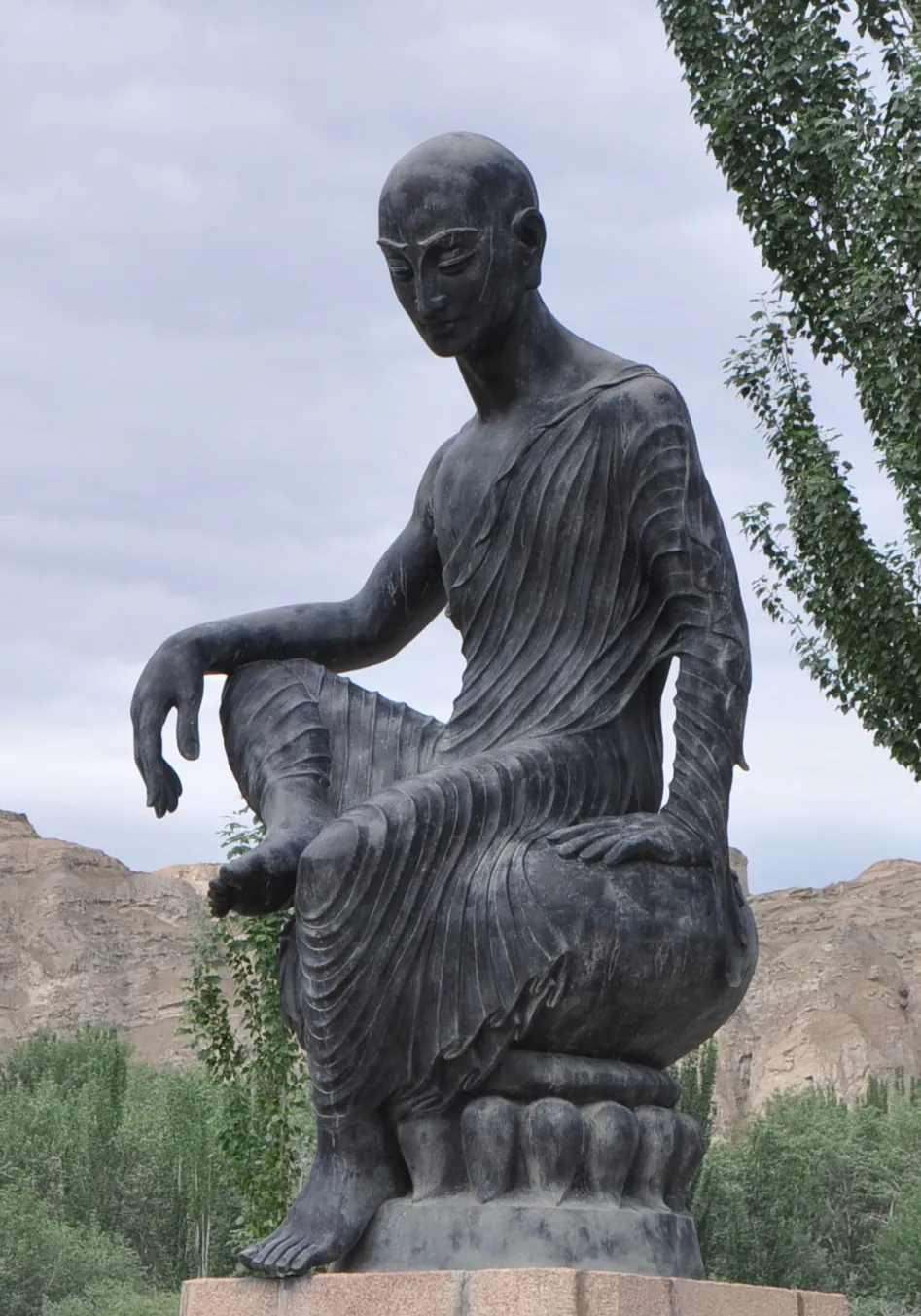
Kumārajīva Settles in Chang'an as Translator
Kumārajīva · कुमारजीव
Kumārajīva, a Buddhist monk from Kucha who lived from 344 to 413 CE, settled in Chang'an around 401 and led a team that rendered many Sanskrit scriptures into Chinese. He is ranked among the most accomplished translators in the Chinese Buddhist canon and introduced Madhyamaka thought there.
Born in the kingdom of Kucha, in today's Aksu Prefecture of Xinjiang, Kumārajīva became a monk, teacher, missionary and translator. His life is dated to 344–413 CE. He first studied the Sarvāstivāda schools, then learned under Buddhasvāmin, and finally embraced Mahāyāna, pursuing the Madhyamaka philosophy of Nāgārjuna. After he had mastered Chinese, he established himself in Chang'an around 401 with the support of the Later Qin court, in the Sixteen Kingdoms age. There he headed a translation team that included his scribe Sengrui, and the group rendered many Sanskrit Buddhist texts into Chinese. He also introduced the Madhyamaka school to China, where it developed into what became known as Sanlun, the Three Treatise school. Later critics rank him among the finest translators in Chinese Buddhism, and Lu Cheng found his versions unrivalled for both method and fidelity. His work was a major influence on how Buddhism was read and written in Chinese, and it shows how Indian Buddhist thought travelled across Central Asia. The year chosen marks his arrival in Chang'an and the start of his great translation project.
Sources
- Kumārajīva Wikipedia · CC-BY-SA-4.0
- Q335293 Wikidata · CC0-1.0