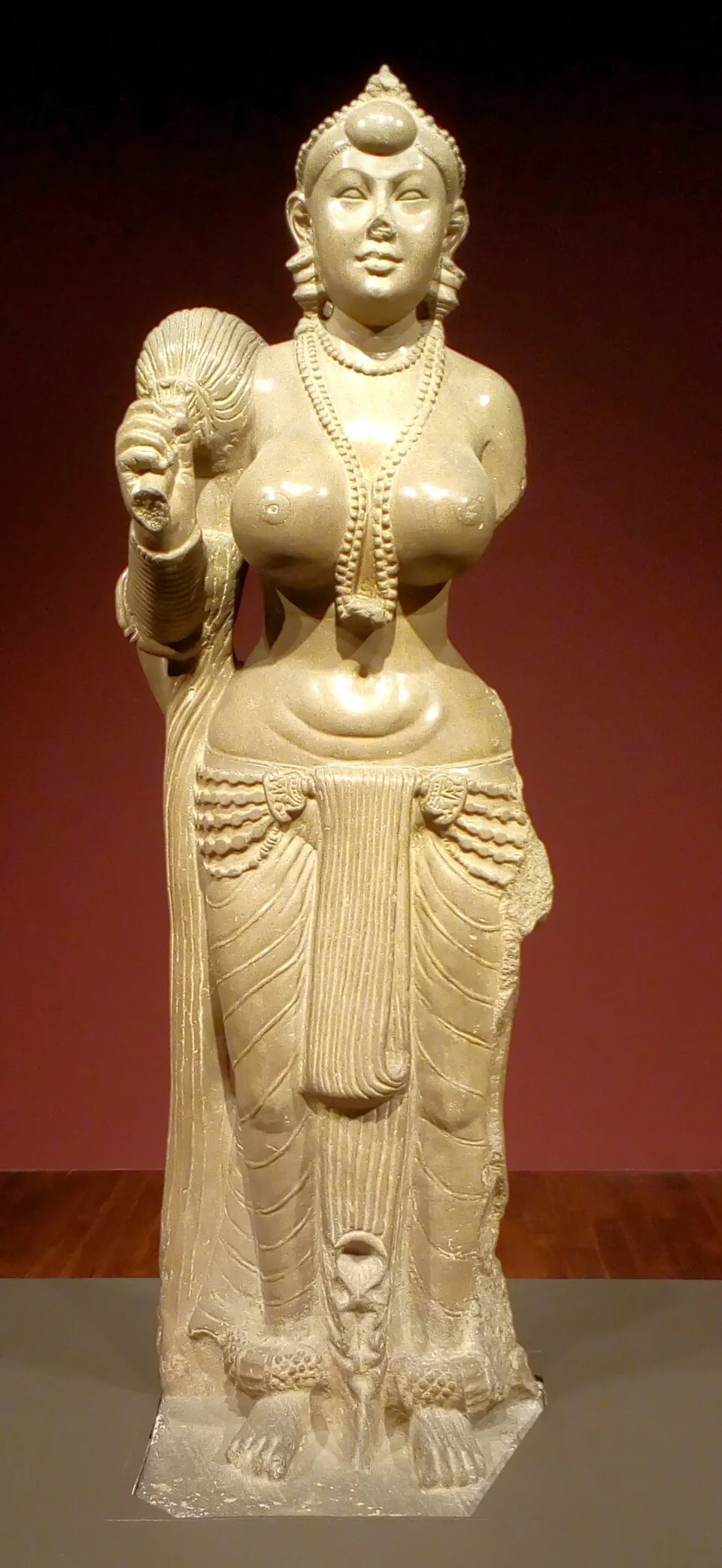
The Didarganj Yakṣī, a Polished Stone Sculpture from Patna
Dīdārgañj Yakṣī · दीदारगंज यक्षी
Disputed: from 3rd century BCE to 2nd century CE.
The Didarganj Yakṣī is a life-size, mirror-polished sandstone figure holding a fly-whisk, found near Patna in 1917 and now in the Bihar Museum. Once dated to the Mauryan period, it has also been assigned to a much later age, as late as the first or second century CE.
The Didarganj Yakṣī, or Didarganj Chauri Bearer, is regarded as one of the finest early Indian stone statues. Chunar sandstone, with a surface polished to a mirror-like finish, was used for the figure, which stands 1.57 metres tall on a pedestal about half a metre high. It is a tall, well-proportioned, free-standing woman who holds a chauri, or fly-whisk, in her right hand, while the left hand is broken. The sculpture was found in 1917 near Patna, the ancient Pāṭaliputra and Mauryan capital, and now rests in the Bihar Museum there. For many years it was dated to the third century BCE because of the polish associated with Mauryan art. But the polish continued for some time after the empire fell, and another yakṣī found without the same finish, together with the treatment of the forelock, which is said to be characteristic of Kuṣāṇa work, has led some scholars to prefer a date in the first or second century CE. The question has not been settled, so the date given here is an approximate midpoint of the range. In either case, the figure is a key example of the confident naturalism of early Indian sculpture.
Sources
- Didarganj Yakshi Wikipedia · CC-BY-SA-4.0
- Q5274083 Wikidata · CC0-1.0