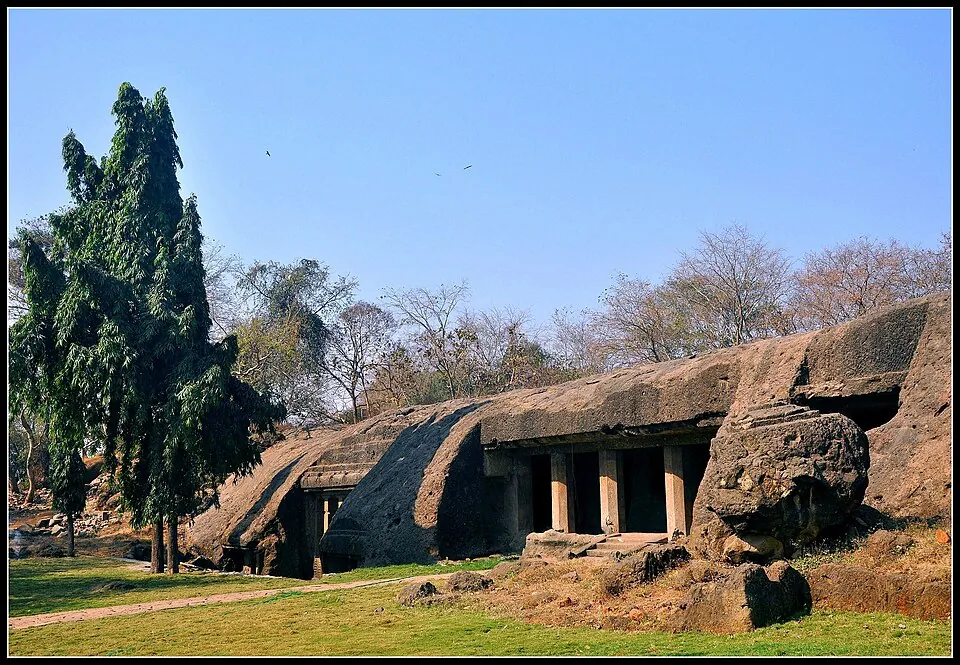
Mahakali Caves, Buddhist Monastery in Mumbai
Mahākālī Guhāyeṁ · महाकाली गुफाएँ
The Mahakali Caves, also called the Kondivita caves, form a group of nineteen rock-cut Buddhist monuments in Andheri, Mumbai. They were excavated over a very long period, from roughly the fourth century BCE to the sixth century CE, and include a chaitya hall with a stupa.
In the eastern suburb of Andheri in Mumbai lies a cluster of nineteen caves cut into black basalt, known as the Mahakali Caves or the Kondivita caves. They formed a Buddhist monastery. Four caves lie to the north-west and fifteen to the south-east, and the south-eastern group is the older of the two, while the north-western caves were made mainly in the fourth and fifth centuries CE. Estimates of the overall period of work range from the fourth century BCE to the sixth century CE, so this entry shows a span rather than a single year. Within the south-eastern group, Cave 9 is a chaitya, a prayer hall holding a stupa with a hemispherical dome. Its entrance wall follows the manner of the Sudama cave in Bihar associated with Ashoka. Cave 9 also has seven carved figures of the Buddha and other beings of Buddhist lore, though all have been defaced. The same volcanic rock was used at the nearby Jogeshwari caves. The stone is a weak breccia that weathers easily, which has harmed many carvings. The monuments show that Buddhist communities were settled in the Mumbai area long before the modern city arose, probably served by trade routes along the Konkan coast.
Sources
- Mahakali Caves Wikipedia · CC-BY-SA-4.0
- Q6732862 Wikidata · CC0-1.0